

CAR
INSURANCE
FOR
17-YEAR-OLDS:
COSTS, LEGAL OPTIONS,
AND THE CHEAPEST
WAY
TO GET COVERED
- Can a 17-year-old buy car insurance alone? In many cases, not easily. A 17-year-old often needs a parent, guardian, or another adult involved because contract rules for minors and insurer underwriting requirements can limit independent purchase. The exact setup depends on state law and the insurance company.
- Cheapest setup? In most cases, staying on a parent’s existing policy is still the cheapest starting point. After that, the biggest savings usually come from telematics, good-student eligibility, and choosing a lower-risk vehicle.
- Typical cost at 17? Insurance at 17 is usually expensive, especially for full coverage. National averages can help set expectations, but the real quote will depend heavily on the household policy, vehicle, address, and insurer.
- Must you list a permit holder? Usually yes. Insurers typically require teens with learner’s permits to be listed on household policies. — Zacks, 2024.
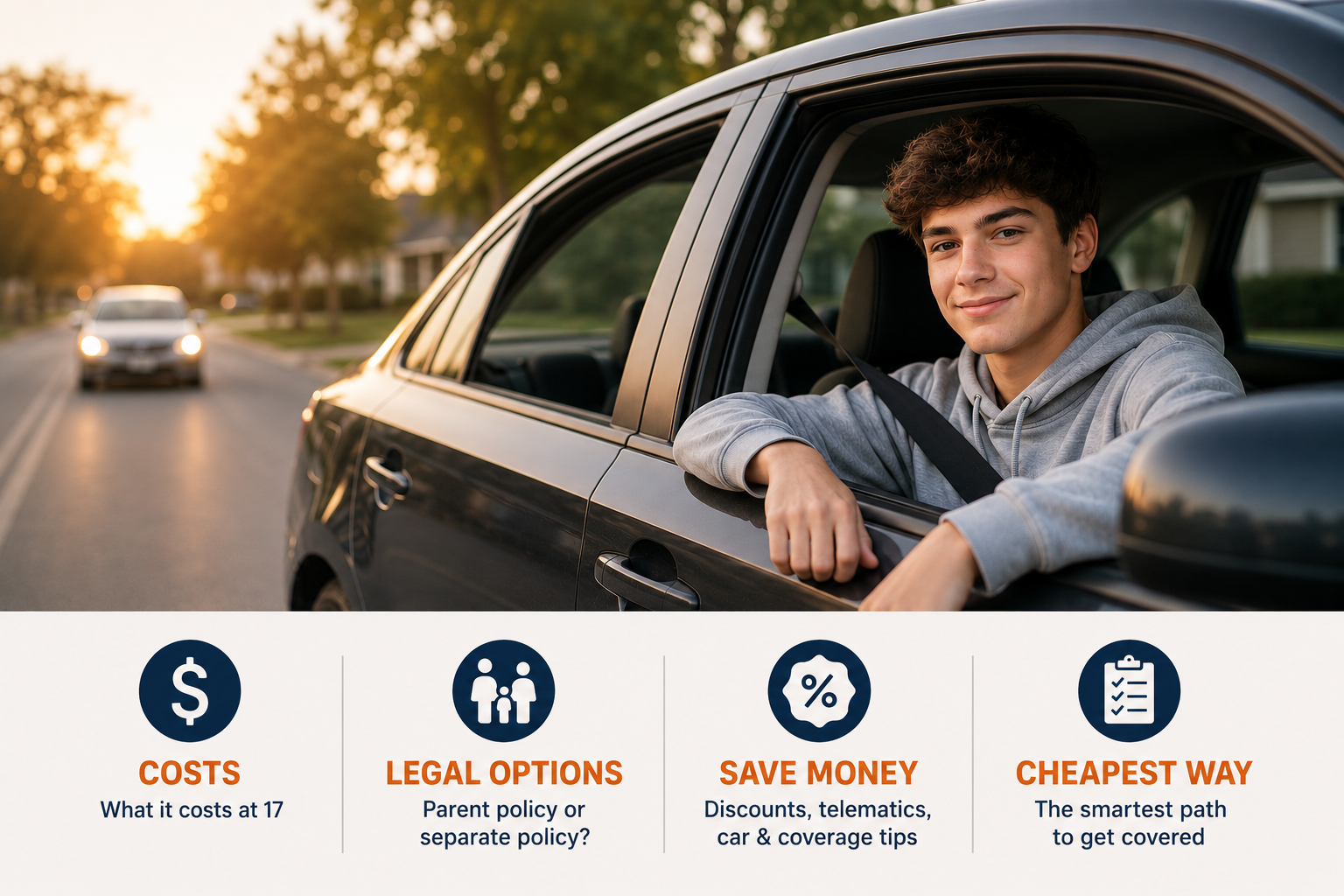
WHAT IT COSTS AT 17: AVERAGES AND WHEN RATES DROP
Typical premiums and when they decline
Insurance is usually expensive at 17 because the driver has limited experience and a short rating history. Rates often improve over time, but the first meaningful savings usually come from staying claim-free, using the right vehicle, and keeping the policy structure clean — not from age alone.What drives the price most
The price usually moves the most based on four things: who the teen is insured with, what car is being insured, where the car is kept, and how much liability protection is chosen. For most families, the biggest mistake is focusing only on the teen’s age while ignoring the vehicle, the garaging address, or the difference between a parent policy and a separate policy.

Add to Parent vs Separate Policy: Choose the Right Setup
Which is cheaper and exceptions
For most 17-year-olds, the lowest-cost setup is still being added to a parent or guardian’s existing policy instead of buying separate coverage. That is usually where the household can keep multi-car, bundling, and tenure-based pricing advantages. A separate policy becomes more realistic only when ownership, garaging, household driving history, or underwriting rules make the family policy a poor fit. A separate policy may make more sense when the parent has a poor driving record, when the car is titled only to the teen, or when the vehicle is kept at a different address than the household policy shows. Those situations can change underwriting enough that the «cheap parent policy» assumption stops being true.Requirements and pitfalls
Before buying or titling the car, check whether the insurer will allow that vehicle on the household policy. Some insurers are comfortable when the car is titled to the parent or jointly. Others may require a separate policy if the vehicle is titled only to the teen. If you ignore that step, you can end up with the wrong policy structure from day one. The address where the car is actually kept matters more than many families expect. If the teen lives part-time somewhere else or the vehicle is regularly parked away from the household address, that can change underwriting and sometimes force a different policy setup. Check that before you buy the car, not after.| Scenario | Usually cheaper setup | Why | What to verify |
|---|---|---|---|
| Standard household | Add to parent’s policy | Household pricing advantages often make this the lower-cost option. | Confirm the teen lives at the same address and the vehicle can stay on the household policy. |
| Parent with poor driving history | Separate policy may be worth comparing | The parent’s record can make the household policy much more expensive. | Compare both setups and check whether the parent’s history is driving the quote up. |
| Vehicle titled only to the teen | Separate policy is often more realistic | Some insurers will not keep that vehicle on the parent’s policy. | Check ownership rules before buying or titling the car. |
| Car kept at a different address | Separate policy may be required | The actual garaging location can change underwriting and eligibility. | Verify where the vehicle is kept most of the time and how the insurer wants it listed. |
| Low-risk vehicle and strong household profile | Add to parent’s policy | A safer vehicle and a clean household record often support better pricing. | Make sure the vehicle, drivers, and garaging details all match the application. |
| Teen needs separate underwriting review | Separate policy | Ownership, address, or driver setup may not fit the household policy. | Confirm whether the insurer accepts the teen, the vehicle, and the address under one policy. |
Pay Less Today: Discounts, Telematics, Car and Coverage Tweaks
Discounts and programs that move the needle
If the goal is to lower the price quickly, focus on the discounts that usually matter most first: telematics, good-student eligibility, and staying on an existing household policy when possible. Smaller items like paperless billing or autopay may help a little, but they do not usually change the quote as much as the policy structure, vehicle choice, or driving-score programs. Do not assume discounts stack neatly in a predictable order. Insurers calculate them differently, and some discounts may not combine the way consumers expect. The practical move is to request quotes both with and without telematics, confirm good-student eligibility, and compare the final premium rather than relying on generic savings examples. Some insurers offer student-related discounts when the teen studies away from home and does not keep regular access to the vehicle. Eligibility rules vary, so treat this as a possible extra — not as a core savings strategy. Required documentation by discount:- Good student: GPA transcript or report card (B average or better).
- Driver’s education: certificate of completion.
- Telematics: app download/device installation; consistent data transmission.
- Distant student: school enrollment verification, proof of garaging at family residence.
Car, coverage, deductibles—what to change safely
Choose a vehicle that is cheaper to repair, less likely to be stolen, and less likely to be rated as a performance risk. For teen drivers, the wrong car choice can push the premium up fast, even before coverage selections are adjusted. The cheapest quote is not always the safer choice. Cutting liability down to the state minimum may save money upfront, but it can leave the household badly exposed after a serious at-fault crash. A better approach is to compare at least two versions of the quote — one near the minimum and one with meaningfully stronger liability limits — and see how much real premium difference there is. Common mistake: Cutting liability limits to state minimums to save premium, exposing the household to significant personal liability in a serious at-fault accident.How to Compare Coverage at 17 Without Relying on State Minimums
Minimums vs stronger protection
State minimum liability limits are often insufficient for real-world injury and property damage costs. Teens face high-severity risk due to inexperience. A single at-fault accident involving serious injuries can generate claims far exceeding state minimums. For most families, the better question is not «What is the one right coverage setup?» but «How much extra protection do we get for the added premium?» That comparison matters more than copying a generic recommendation, especially when state rules, vehicle value, household finances, and insurer underwriting can differ so much.How to compare quote versions in practice
State minimum coverage may be enough to drive legally, but it may not be enough to absorb the financial damage from a serious crash. That matters even more for teen drivers because one early at-fault accident can create a large liability problem for the household. Instead of copying a generic coverage matrix, compare quotes in versions. Look at how the premium changes when liability protection is increased, when deductibles are adjusted, and when coverages such as UM/UIM, collision, or comprehensive are added or removed. That gives a more realistic decision than relying on one universal set of limits.NY Quick Facts: Requirements and Local Context
NY quick facts
If the policy is being written in New York, do not rely on generic national advice alone. New York has its own minimum liability requirements, no-fault rules, and insurer procedures. For teen drivers, especially minors, permit holders, or households with unusual ownership or garaging arrangements, the safest move is to verify current rules directly with NY DFS, NY DMV, and the insurer before binding coverage.Step-by-Step: How to Get Insured at 17
If joining a parent/guardian policy
If the teen is joining a household policy, start by confirming three basics: who owns the car, where it is actually kept, and whether the permit holder or licensed teen must be listed now. Those details affect both price and underwriting, and getting them wrong early can create bigger problems later. Once the vehicle and policy structure make sense, compare the quote in more than one coverage version and confirm the effective date before the teen drives alone. After that, finalize billing, make sure the teen is correctly listed, and keep proof of insurance ready for the vehicle.Steps
- Confirm the policy can legally and practically fit the teen, the vehicle, and the garaging address.
- Compare quotes in more than one coverage version, not just by headline price.
- Bind coverage only after discounts, listed drivers, and effective date are confirmed in writing.
If standalone with an adult co-signer
If a separate policy is the only realistic option, check three things before moving forward: whether the insurer accepts that setup for a minor, whether the vehicle title and garaging address fit the application, and whether the final premium still makes sense compared with staying on a household policy. Separate coverage can solve a policy-fit problem, but it often stops being the lower-cost option.Steps
- Verify co-signer requirements and state rules regarding minor policyholders. Confirm that the co-signer meets the insurer’s eligibility criteria.
- Choose an insurable, low-risk vehicle. Set higher deductibles if needed to manage premium. Enroll in telematics if the insurer offers usage-based pricing.
- Bind the policy. Schedule telematics device installation or mobile app activation. Plan to re-shop at 6 to 12 months of clean driving to compare rates and potentially transition to a lower-cost option.
Documents and Common Errors Checklist
Most teen-policy problems do not start with complicated legal issues. They start with bad details: the wrong garaging address, a missing household driver, a title mismatch, or discount paperwork that does not match the application. That is why the review step matters before the policy is bound. Before you bind:- Match names on license, vehicle title, and policy application.
- Confirm VIN accuracy.
- Verify garaging address matches where vehicle is kept most of the time.
- List all household drivers (including permit holders).
- Submit required documents for discounts (GPA transcript, driver’s ed certificate).
- Review coverage selections and ensure lienholders are satisfied (if financed).
- Mismatch between garaging address and actual vehicle location.
- Failure to disclose all household drivers.
- Incomplete or expired driver’s education certificates.
- VIN errors.
- Insufficient proof of good student status.
When It Makes Sense to Compare Quotes Again
Re-shop the policy after a clean renewal period, after the teen moves from permit to licensed driving, after a vehicle change, or when a meaningful discount becomes available that was not on the original policy. In practice, the first smart re-check is often around the first renewal rather than on an arbitrary age milestone.Common mistakes that make teen insurance harder or more expensive
Families often overfocus on the teen’s age and underfocus on the details that actually change underwriting. The most common mistakes are buying the car before checking policy fit, using the wrong garaging address, failing to disclose all household drivers, and chasing the lowest quote without comparing liability protection.FAQ
A non-owner policy may be available in some cases, but it is not the standard solution for most 17-year-olds. It usually makes sense only when the teen does not own a car, does not have regular access to one household vehicle, and still needs liability coverage for occasional driving. Eligibility depends heavily on the insurer and state-specific rules.
Paying in full can reduce total cost with some insurers, but the real benefit varies. What matters is not only whether there is a pay-in-full discount, but also whether monthly billing adds service fees, financing charges, or other costs that make installment payments more expensive overall.
A 17-year-old may be able to own a vehicle, but ownership and insurance eligibility are not the same issue. Even when a teen can hold title, the insurer may still require a different policy structure, an adult’s involvement, or a separate underwriting review.
A learner’s permit typically requires the teen to be listed on the household insurance policy. Most insurers require disclosure of all household drivers, including those with learner’s permits. Insurers generally require learner’s permit holders to be disclosed and listed on household policies. — Zacks, 2024. The teen is usually covered under the household policy while driving with a licensed adult. Once the teen obtains a full license, the insurer may adjust the rating to reflect the teen’s independent driving exposure. Check state law and insurer requirements to confirm permit-holder listing and coverage.