

CAR RENTAL INSURANCE IN THE U.S.: CDW, LIABILITY COVERAGE, PAI, AND OTHER OPTIONS
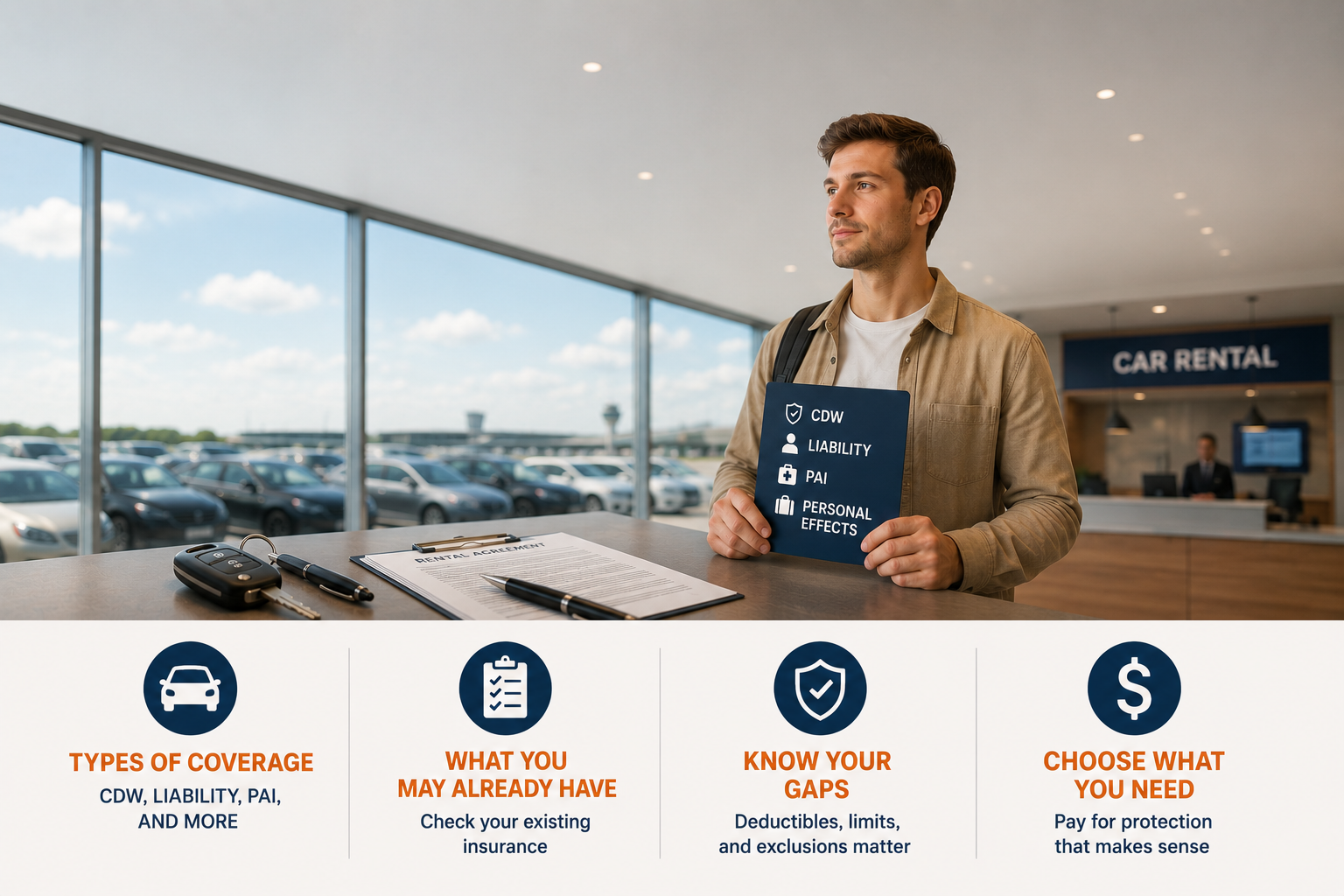
«Rental car insurance» is a general term for several different products. At the rental counter, you may be offered a collision or loss damage waiver, supplemental liability insurance, personal accident insurance, and personal effects coverage. These products do not protect against the same risks.
You may already have some protection through your personal auto policy, health insurance, homeowners or renters insurance, or an eligible credit card. However, existing coverage may have deductibles, territorial limits, excluded vehicle types, claim requirements, or gaps such as loss-of-use and administrative charges.
WHAT IS RENTAL CAR INSURANCE IN THE U.S.?
Before accepting or declining any rental company product, identify four things: what protection is included in the rental rate, what your existing policies cover, how much you could be required to pay after a loss, and whether the rental will be used only for permitted personal use.
The information below applies to personal-use car rentals in the United States. It does not address fleet, commercial, delivery, or for-hire rental arrangements.


Main Types of Rental Car Protection
Rental protection terms vary by rental company, pickup location, state, and selected package. Before signing the agreement, check what is included in the quoted rate, which products are optional, what deductible or financial responsibility remains, and which uses or types of damage are excluded.Collision and Theft Protection: CDW and LDW
Collision Damage Waiver (CDW) or Loss Damage Waiver (LDW) may reduce or waive the renter’s contractual responsibility for covered damage to, or theft of, the rental vehicle. It is generally a waiver offered under the rental agreement rather than standard auto insurance. Its effect depends on the selected package, any deductible or retained responsibility, listed exclusions, and compliance with the agreement. Depending on the rental agreement, CDW or LDW may address covered repair costs and theft-related losses. Towing, loss-of-use charges, diminished value, administrative fees, glass, tires, wheels, the roof, and undercarriage may be included, limited, or excluded. Some products waive most covered charges, while others leave the renter responsible for a stated amount. CDW or LDW should not automatically be interpreted as «zero out-of-pocket cost.» Check whether the agreement leaves you responsible for a deductible, excluded vehicle parts, unauthorized use, loss-of-use charges, administrative fees, or damage that results from violating the rental terms. Exact exclusions vary by rental company and protection package. Common items to verify include:- Glass, mirrors, lights, tires, and wheels
- Roof, undercarriage, or interior damage
- Lost keys, lockouts, or misfueling
- Unauthorized drivers
- Driving outside the permitted territory
- Off-road or prohibited use
- Reckless driving or driving under the influence
- Damage reported outside the required claim procedure
Liability and Injury Coverage: SLI and PAI
Supplemental Liability Insurance (SLI) may increase the liability protection available for covered bodily injury or property damage claims made by other people. It does not cover damage to the rental vehicle itself. The amount of liability protection already included with a U.S. rental varies by state, rental company, and agreement. Do not assume that the minimum protection supplied with the rental matches the limits on your personal auto policy. Before purchasing SLI, check:- the bodily injury and property damage limits already available;
- whether your personal auto liability coverage extends to the rental;
- whether SLI is primary or excess over other applicable insurance;
- whether the stated limit includes or sits above the underlying protection;
- excluded drivers, prohibited uses, and territorial restrictions.
Personal Effects Coverage (PEC): Protecting Belongings in the Cabin
What is PEC? Personal Effects Coverage (PEC) may cover specified personal belongings stolen from the rental vehicle, subject to an aggregate limit, per-item limits, exclusions, and claim documentation requirements. The available limits vary by rental company and product. What PEC May Cover:- luggage, clothing, and other eligible personal property stolen from the rental vehicle;
- specified electronics, subject to per-item and aggregate limits;
- property belonging to covered passengers, if the policy includes them.
- cash, jewelry, collectibles, and other high-value property;
- items left in an unlocked vehicle or without evidence of theft;
- business equipment or property exceeding the per-item limit;
- losses not supported by a required police report or proof of ownership;
- property recoverable under another applicable policy.
- You don’t have homeowners/renters insurance or travel insurance with baggage coverage.
- You prefer a separate rental-company product after comparing its cost, deductible, limits, and exclusions with your existing property coverage.
- Report the theft to local law enforcement as soon as possible when required by law, the rental agreement, or the applicable coverage terms.
- Notify the rental company and coverage provider as soon as possible and within the deadlines stated in the rental agreement and policy.
- Provide receipts or proof of ownership for stolen items, photos of forced entry or damage, and any other documentation requested.
Rental Car Protection Comparison
Coverage Summary Table
| Product | Main risk addressed | Does not normally replace | What to verify |
|---|---|---|---|
| CDW or LDW | Contractual responsibility for covered damage to or theft of the rental vehicle | Liability for injuries or damage to other people | Remaining responsibility, excluded parts, loss of use, and administrative fees |
| SLI | Covered bodily injury and property damage claims made by third parties | Damage to the rental vehicle | Available base limit, total SLI limit, and primary or excess status |
| PAI | Defined accident benefits for covered occupants | Full health insurance or liability coverage | Covered persons, benefit limits, exclusions, and duplicate coverage |
| Personal Effects Coverage | Theft of specified personal belongings | Damage to the rental vehicle or third-party liability | Per-item limits, aggregate limit, deductible, and proof requirements |
Coverage You May Already Have
Personal Auto Insurance
A personal auto policy may extend some liability, collision, and comprehensive coverage to a rental vehicle used for personal purposes in the United States. The scope of protection depends on the policy, state rules, vehicle type, and circumstances of the rental. Before declining the rental company’s CDW or LDW, ask your insurer:- whether liability coverage extends to the rental;
- whether collision and comprehensive coverage apply;
- which deductible would apply;
- whether loss of use, diminished value, towing, storage, and administrative fees are covered;
- whether the vehicle class or value creates a limitation;
- whether every planned driver is covered;
- whether delivery, rideshare, or other business use is excluded.
Credit Card Rental Benefits
Some credit cards include a rental vehicle damage or theft benefit when an eligible rental is paid for with the card. The card network name or card tier alone does not confirm that the benefit is included. Read the current Guide to Benefits for your exact card account. Verify:- whether the benefit is primary or secondary;
- whether you must decline the rental company’s CDW or LDW;
- whether the full rental cost must be charged to the card;
- whether additional drivers are covered;
- which vehicle types are excluded;
- the maximum eligible rental period;
- whether loss of use, towing, and administrative fees are covered;
- how quickly an incident must be reported;
- which documents are required for a claim.
Third-Party Rental Car Protection
Independent rental vehicle protection may be available through a travel insurer or specialized provider. These products are not automatically equivalent to the rental company’s CDW or LDW. Some third-party policies use a reimbursement model. After a covered loss, the rental company may charge the renter first, and the renter must then submit a separate claim for reimbursement. This can require sufficient available credit or cash while the claim is reviewed. Before purchasing a third-party product, verify:- whether the policy is available in your state;
- whether it covers the full value of the rental vehicle or only a deductible;
- whether it includes theft, loss of use, towing, administrative fees, glass, tires, keys, and undercarriage damage;
- whether luxury vehicles, trucks, vans, or long-term rentals are excluded;
- whether liability coverage is included;
- whether the rental company must be paid before reimbursement;
- which police reports, photographs, receipts, and rental documents are required.
What to Do After an Accident or Theft with a Rental
If an accident, theft, vandalism, or other loss occurs, follow the rental agreement and every applicable insurance or card-benefit reporting requirement. Do not assume that all providers use the same deadline.At the scene
- Move to a safe location when possible and call emergency services if anyone is injured.
- Follow state law concerning police reports and information exchange.
- Photograph the vehicles, license plates, road conditions, damage, and relevant signs or signals.
- Collect the other driver’s name, contact information, vehicle information, and insurance details.
- Avoid speculating about fault. Provide accurate factual information.
Notify the rental company
Contact the rental company as soon as it is safe to do so. Use the emergency or claims number in the rental agreement and request written instructions. Ask whether the vehicle may be driven, where it should be returned or towed, and which incident forms are required.Notify every applicable coverage provider
If you may rely on a personal auto policy, credit card benefit, travel policy, or third-party rental protection, notify each provider within its stated deadline. One provider’s notification does not automatically satisfy another provider’s requirements.Keep copies of
- the rental agreement;
- the vehicle inspection report;
- photographs and videos;
- the police report or incident number, when applicable;
- towing and storage receipts;
- the rental company’s damage report and repair estimate;
- correspondence with the rental company and insurers;
- claim reference numbers.
Mistakes That Can Jeopardize a Claim
A claim may be delayed, limited, or denied if the renter uses an unauthorized driver, violates territorial or use restrictions, misses a reporting deadline, fails to obtain a required report, provides incomplete documentation, or continues driving an unsafe vehicle. The consequence depends on the agreement, policy, and facts of the incident.Checklist Before You Accept or Decline Rental Car Coverage
- Read the rental agreement for permitted drivers, territory, prohibited use, reporting duties, and damage charges.
- Check what liability and vehicle damage protection is already included in the quoted rate.
- Ask your auto insurer whether liability, collision, and comprehensive coverage extend to the rental.
- Confirm the deductible and whether loss of use, diminished value, administrative fees, towing, and storage are covered.
- Read the current Guide to Benefits for the exact credit card you will use.
- Confirm whether the card benefit is primary or secondary and whether declining CDW or LDW is required.
- Check excluded vehicle types and the maximum eligible rental period.
- Determine whether a third-party policy pays the rental company directly or reimburses you after you pay.
- Make sure every driver is authorized under the rental agreement.
- Inspect and photograph the vehicle before leaving the rental location.
- Save the agreement, inspection report, policy documents, benefit guide, and claim contact information.
- Confirm that the vehicle will be used only for purposes permitted by the agreement and applicable coverage.
Quick Decision Guide for U.S. Rentals
You have personal auto insurance with collision and comprehensive
Ask whether it extends to the rental, which deductible applies, and whether loss of use, diminished value, and administrative fees are covered. Compare those terms with the rental company’s CDW or LDW.You have a credit card with a rental benefit
Read the current Guide to Benefits. Confirm that the rental, vehicle, driver, duration, and payment method are eligible. Do not assume the benefit includes third-party liability.You do not carry personal auto insurance
Determine what liability protection is included in the rental and review the rental company’s vehicle damage waiver. A credit card benefit may cover eligible damage to the rental vehicle but normally should not be treated as liability insurance.You are concerned about medical expenses
Compare PAI with your health insurance, MedPay or PIP coverage, and any travel or accident policy.You are concerned about belongings in the vehicle
Compare PEC with off-premises coverage under homeowners, renters, or travel insurance.You plan to use the vehicle for delivery, rideshare, or other paid work
Stop and confirm that the rental agreement and insurance expressly permit commercial or for-hire use.Comparison Table: Counter vs. Card vs. Third-Party vs. Personal Policy
| Coverage source | What it may provide | Main limitation | Document to check |
|---|---|---|---|
| Rental company CDW or LDW | May reduce contractual responsibility for covered damage to or theft of the rental vehicle | May contain exclusions and does not normally replace third-party liability coverage | Rental agreement and waiver terms |
| Rental company SLI | May provide additional protection for covered third-party liability claims | The limit and relationship to underlying coverage vary | SLI policy or coverage summary |
| Personal auto policy | Liability, collision, and comprehensive coverage may extend to a personal-use rental | Deductibles, exclusions, state rules, and claim consequences apply | Auto policy and written insurer confirmation |
| Credit card benefit | May cover eligible damage to or theft of the rental vehicle | May be primary or secondary and normally does not replace liability coverage | Current Guide to Benefits |
| Third-party rental policy | May reimburse eligible rental vehicle damage charges | The renter may have to pay first, and exclusions vary | Insurance policy and claim terms |
| Health insurance or PAI | May address specified medical expenses or accident benefits | Does not cover damage to the rental vehicle or third-party liability by itself | Health plan documents or PAI certificate |
| Homeowners, renters, or PEC | May address theft of eligible personal belongings | Deductibles, per-item limits, aggregate limits, and exclusions apply | Property policy or PEC terms |
FAQ
You may be able to decline the rental company’s CDW or LDW if your exact card benefit covers the rental and requires or permits you to decline the waiver. Confirm the eligible vehicle type, rental period, payment method, authorized drivers, exclusions, and claim process before making that decision.
PAI may overlap with health insurance, MedPay, PIP, travel insurance, or accidental death coverage, but the benefits are not necessarily identical. Compare the covered persons, benefit limits, deductibles, exclusions, and payment method before deciding.
It may. Some card benefits require you to decline the rental company’s CDW or LDW. Purchasing the waiver may therefore make the card benefit unavailable for that rental. Check the current Guide to Benefits before accepting coverage at the counter.
No. SLI addresses covered third-party bodily injury or property damage claims. Damage to the rental vehicle is addressed separately through CDW or LDW, applicable personal auto coverage, an eligible credit card benefit, or another qualifying policy.
It depends on the exact card benefit. Check whether the current Guide to Benefits expressly includes loss-of-use charges and what documents the administrator requires from the rental company.
Check the off-premises or personal property section of your policy. Coverage may apply subject to a deductible, per-item limits, excluded property, claim documentation requirements, and any off-premises coverage limit. Confirm the terms with your insurer before relying on the policy.