

Месяц: Июль 2026
UBER INSURANCE WHAT INSURANCE DO YOU NEED TO DRIVE FOR UBER?
If you drive for Uber in New York, the first issue is not price. It is whether your current policy actually covers you when the app is on. Outside New York City, many drivers solve the gap with a rideshare endorsement or a hybrid policy. In NYC under TLC rules, that usually is not enough: drivers typically need TLC-compliant commercial coverage and the required filing. The mistake that causes the most trouble is assuming a personal auto policy will carry over cleanly into rideshare use.
If you drive under TLC rules in New York City, the decision path is different from the rest of the state. A standard personal policy with a rideshare endorsement is generally not the same thing as TLC-compliant commercial coverage. Outside NYC, many drivers use a personal policy plus a rideshare endorsement or a hybrid policy, but in NYC the key question is whether the policy structure and filing actually satisfy TLC requirements.

UNDERSTANDING UBER’S PROVIDED INSURANCE COVERAGE
Uber’s coverage is easier to understand if you stop treating it like a full replacement for your own insurance. It changes depending on whether you are offline, waiting for a request, or actively on a trip. The practical issue is not just that the platform provides coverage in some stages, but that your own policy can still determine whether a claim becomes clean, limited, or disputed.
Coverage by driver status
Offline: Your personal auto policy applies. Uber’s coverage is not active. If you have a claim during this period, your personal insurer reviews it under your policy terms. Uber’s platform coverage changes by driver status, but drivers should not rely on generic internet numbers as the final answer for their situation. The practical point is simpler: when you are offline, your own policy controls; when the app is on, coverage can shift; and when a trip is active, Uber’s platform coverage is broader than it is during waiting time. The detail that matters most is not memorizing a national summary number, but understanding whether your own policy, endorsement, deductible structure, and vehicle use line up with that platform coverage. On trip (accepted request through drop-off, Periods 2 and 3): Platform coverage is generally broader during an active trip than it is while waiting for a request, but drivers still need to understand how their own policy, deductible structure, and physical damage coverage interact with that protection. The important question is not whether a generic national number sounds high enough, but whether the policy setup actually works for the vehicle and the driver’s use case.Key gaps and conditions
Uber’s policy is designed for the platform. Your personal policy terms still matter. Collision and comprehensive coverage while on trip are often contingent on your own policy having those coverages. Some losses — such as damage to personal items, certain fees, or specific types of accidents — may be excluded. Review your policy documents to understand when liability, collision, and comprehensive coverage triggers, what limits apply, and what deductibles you will owe. The gap that catches many drivers is the time when the app is on but no trip has started yet. That is the point where a standard personal policy may not respond the way a driver expects, while platform coverage may still be limited. In practice, this is why a rideshare endorsement or a properly structured hybrid policy matters: not because it sounds better on paper, but because it can reduce the mismatch between how the car is actually being used and how the risk is insured. NYC TLC drivers: If you operate under a TLC license in NYC, Uber’s coverage supplements — but does not replace — your TLC-required commercial liability policy. You must maintain a TLC-compliant policy with the minimum liability limits mandated by the TLC, and file the FH-1 form. Uber’s platform coverage does not satisfy the TLC’s insurance requirements on its own.|
Driver Status |
Whose Policy Applies |
Liability Coverage |
Collision Coverage |
Comprehensive Coverage |
Notes and Conditions |
|---|---|---|---|---|---|
|
Offline |
Personal policy |
Per personal policy terms |
Per personal policy terms |
Per personal policy terms |
Uber coverage is not active; personal policy may exclude rideshare use if no endorsement |
|
Waiting for request (Period 1) |
Uber policy (limited) |
Uber provides third-party liability |
Generally not covered by Uber |
Generally not covered by Uber |
Personal policy may deny claim if it excludes commercial use; endorsement or hybrid policy recommended |
|
On trip (Periods 2 and 3) |
Uber policy (primary) |
Uber provides primary liability |
Contingent on personal policy coverage |
Contingent on personal policy coverage |
Deductible obligations may still apply, and contingent physical damage coverage depends on how the driver’s own policy is structured |


NYC (TLC) vs. Rest of New York: What You Need and What Documents Are Required
If you drive in New York City (under TLC jurisdiction)
NYC rideshare drivers must comply with TLC regulations. A personal auto policy with a rideshare endorsement is not sufficient. You must:- Obtain a TLC-compliant commercial auto insurance policy that meets TLC minimum liability limits (verify current limits at NYC TLC Insurance Requirements).
- File an FH-1 certificate with the TLC. This certificate is issued by your insurance carrier and proves that your policy meets TLC standards. Your insurer must be licensed to provide TLC coverage in NYC.
- Maintain coverage continuously and update the TLC if you change insurers or policies.
- Driver’s license (valid NYS license with appropriate class)
- Vehicle registration (NYS registration)
- TLC license number (if you already have one)
- VIN (vehicle identification number)
- Garaging address in NYC
- Prior insurance history (declarations page from your current policy, if applicable)
- Proof of TLC vehicle inspection (if required)
- Insurer not authorized to file FH-1 in NYC
- Policy limits below TLC minimums
- Policy does not name the TLC as a certificate holder
- Gaps in coverage dates
- Vehicle not listed on the policy or VIN mismatch
- NYC TLC Insurance Requirements
- NYC TLC FH-1 Information
If you drive outside NYC (rest of New York State)
Outside NYC, you are not subject to TLC regulations. You must:- Maintain a valid personal auto insurance policy that meets New York State minimum liability requirements.
- Add a rideshare endorsement to your personal policy, or obtain a hybrid rideshare policy. This extends your personal coverage to include rideshare activity and closes the Period 1 gap.
- Verify that your insurer offers rideshare endorsements in New York State. Not all carriers offer this coverage.
- Driver’s license (valid NYS license)
- Vehicle registration (NYS registration)
- VIN
- Garaging address
- Driving history (MVR or claims history may be reviewed)
- Current policy declarations page (if switching insurers)
- Confirmation that you will drive for Uber (and other platforms, if applicable)
Decision guide: Which coverage do you need?
- If you drive in NYC and have a TLC license: TLC-compliant commercial policy + FH-1. A personal policy with endorsement is not acceptable.
- If you drive outside NYC (e.g., Buffalo, Rochester, Albany, Long Island but not within TLC jurisdiction): Personal policy + rideshare endorsement, or hybrid rideshare policy.
- If you drive both in and out of NYC: You must maintain the TLC-compliant commercial policy for NYC driving. Consult your insurer about whether that policy covers you adequately outside NYC, or if you need separate coverage.
What this usually means in practice
What this usually means in practice is simple. A part-time driver outside NYC may be able to use a personal policy with a rideshare endorsement if the carrier allows that use. A driver operating under TLC rules in NYC usually needs a different policy structure entirely. A driver who also does delivery work should not assume the same endorsement automatically covers every platform. And a driver using a borrowed or rental vehicle should confirm eligibility before relying on the vehicle for paid driving at all.Why Your Personal Policy Isn’t Enough: The Need for Rideshare Insurance
A personal auto policy is built around private driving, not app-based passenger work. The real problem is not just that rideshare use may be excluded, but that many drivers assume the policy will still work normally once they go online. That assumption is where expensive mistakes begin. If your coverage does not match how the vehicle is actually being used, a claim can become slower, narrower, or more disputed than you expected. The point of rideshare coverage is not to make the policy sound more complete. It is to reduce the gap between real use and insured use.Types of Rideshare Insurance Policies
Choose a rideshare policy that matches your driving pattern, vehicle use, and budget. Compare coverage, limits, deductibles, and insurer requirements before you decide. Rideshare endorsement: An add-on to your personal auto policy that extends coverage for rideshare use. It typically closes the Period 1 gap by providing collision and comprehensive coverage when you are waiting for a request. Not all insurers offer the same rideshare structure, and some carriers separate passenger work, delivery work, and commercial use more strictly than drivers expect. Before choosing an endorsement, confirm exactly what activities it covers. Hybrid policy: A combined personal–rideshare policy that aligns coverage for private driving and rideshare activity. It simplifies claims and limits by treating both uses under one policy. Hybrid policies may offer more consistent deductibles and limits across all driver statuses. They are useful for drivers who spend significant time online and want streamlined coverage. Full commercial insurance: A business-grade auto policy offering the broadest coverage for frequent or multi-platform drivers. Commercial insurance is sometimes required for certain vehicle types, fleet operators, or drivers who also work with taxi, livery, or delivery services (e.g., TLC drivers in NYC). It provides primary coverage regardless of trip status and may be necessary if you operate a transportation business. These options differ by insurer, state, and market. Ask your broker to compare coverage terms, limits, deductibles, exclusions, and documentation requirements. Do not assume one option is universally better. The correct choice depends on your actual vehicle use, driving frequency, income reliance, and risk tolerance.|
Policy Type |
For Whom |
Uber/TLC Acceptable? |
Coverage Highlights |
Notes |
|---|---|---|---|---|
|
Rideshare Endorsement |
Part-time or occasional drivers outside NYC who want to keep a personal-policy structure |
Yes for Uber outside NYC; No for TLC in NYC |
Extends a personal policy to better align with app-on rideshare use, especially around the waiting-for-request stage |
Useful when the carrier allows rideshare use under a personal-policy structure; does not satisfy TLC requirements in NYC |
|
Hybrid Rideshare Policy |
Drivers outside NYC who want one policy structure for both personal and rideshare use |
Yes for Uber outside NYC; No for TLC in NYC |
Combines personal and rideshare use in a single policy structure, which may simplify claims handling and deductible logic |
Useful for drivers who want one policy structure for personal and rideshare use; availability varies by carrier |
|
Commercial/TLC Policy |
NYC TLC drivers and drivers operating in a more commercial use model |
Yes for TLC in NYC; may also be used for Uber depending on the operating setup |
Primary commercial-style coverage designed for for-hire or more business-oriented vehicle use |
Required for TLC driving in NYC and may be appropriate when the vehicle is used in a more commercial operating model |
How to Get the Right Coverage Without Creating a Claim Problem Later
Step 1: Determine your coverage needs
- NYC TLC driver: You need a TLC-compliant commercial policy and FH-1.
- Outside NYC, regular Uber driver: You need a personal policy with a rideshare endorsement or a hybrid rideshare policy.
- Multi-platform or delivery: Verify that your endorsement or policy covers Uber, Lyft, Uber Eats, DoorDash, or other platforms you use.
Step 2: Gather required information for your insurance quote
Prepare the following before contacting an insurer or broker:- Driver’s license: Valid New York State driver’s license (number, expiration, class)
- Vehicle identification number (VIN): For the vehicle(s) you will use for Uber
- Vehicle registration: Current NYS registration
- Garaging address: Where the vehicle is parked overnight (must be in NY)
- Driving history: Approximate years of driving experience; any accidents or violations in the past 3–5 years (insurers will pull an MVR)
- Current insurance policy: Declarations page from your existing policy (if switching insurers or adding endorsement)
- TLC license number (if applicable): For NYC drivers
Step 3: Request and compare quotes
- Contact your current insurer to ask whether they offer a rideshare endorsement or TLC-compliant commercial coverage in New York.
- If they do not offer the right structure, or if the quote does not fit your use case, speak with a licensed broker who works with New York rideshare drivers.
- Compare at least 2–3 quotes on the same basis so you are not comparing different deductibles, different physical damage terms, or different coverage structures.
Step 4: Select and purchase your policy
Before you commit, review how the policy describes your actual vehicle use. Confirm whether rideshare activity is covered at the right stage, whether delivery work is included if relevant, whether physical damage coverage is in place if you need it, and what happens when a claim may involve both your own policy and platform coverage.Step 5: Obtain proof of insurance and upload to Uber/TLC
For Uber (outside NYC):- Your insurer will issue an insurance ID card and a policy declarations page that shows coverage dates, limits, and vehicle information.
- Upload these documents in the Uber Driver app under the Insurance section.
- Uber reviews and verifies your insurance. If approved, you can go online. If rejected, Uber will notify you of the reason (e.g., coverage dates do not match, vehicle VIN mismatch, endorsement not shown).
- Your insurer will file the FH-1 certificate directly with the TLC.
- You will also receive a certificate of insurance for your records.
- Verify with TLC that the FH-1 is on file and accepted before you begin driving.
- Keep a copy of your FH-1 and policy documents in your vehicle.
- Coverage start date in the future or lapsed coverage
- VIN on the insurance document does not match the vehicle registered with Uber/TLC
- Policy does not show rideshare endorsement or TLC compliance
- Insurer not recognized or not authorized in New York
- Limits below Uber’s or TLC’s minimums
- Policy holder name does not match driver name
- Double-check that the VIN, driver name, and coverage dates match your Uber or TLC application exactly.
- Ensure your insurer explicitly states «rideshare» or «TNC» on the policy documents, or that the FH-1 is filed for TLC drivers.
- Upload clear, legible images or PDFs of all pages.
Step 6: Maintain continuous coverage and update as needed
- Renew your policy on time. Uber and TLC require continuous coverage. A lapse can result in deactivation.
- Notify Uber and TLC immediately if you change insurers or vehicles.
- Review your coverage annually or when your driving frequency changes.
Non-Owner, Rental, and Express Drive Scenarios
If you drive a borrowed, leased, or rental vehicle, do not assume the standard rideshare advice still applies without changes. Coverage can shift based on ownership, who is listed on the policy, what the rental agreement allows, and whether the platform has approved that vehicle setup. In these cases, drivers should confirm both platform eligibility and insurance structure before relying on the vehicle for Uber work.Delivery (Uber Eats, DoorDash): Coverage Basics
If you also do delivery work, do not assume it is treated the same way as passenger rides. Personal auto policies often exclude delivery for pay, and platform coverage may be limited or structured differently from rideshare coverage. Some insurers extend gig-use coverage across multiple platforms, while others separate rideshare and delivery exposure or require each activity to be specifically listed. The key question is whether your own policy structure matches every type of paid driving you actually do.Factors That Affect Your Rideshare Insurance Premium and Deductibles
Price is driven less by a single ‘rideshare surcharge’ and more by the overall risk profile: your driving history, vehicle, location, time on the road, and the policy structure you need. For many drivers, the most important cost decision is not the headline premium but the trade-off between deductible exposure, physical damage coverage, and whether the policy actually fits all of their gig activity.What to Do After an Accident While Driving for Uber
If an accident happens, protect safety first. Then report and document promptly to preserve claim rights under every policy — Uber’s and your own. Keep communications factual and consistent. Follow these steps:1) Ensure safety
Move to a safe area if the vehicle is drivable. Check for injuries among all parties. Call emergency services if anyone is injured or if there is significant property damage.2) Secure information
Collect contact information, driver’s license details, and insurance information from all parties involved. Obtain contact details from witnesses. Note the time, location, weather, road conditions, and vehicle details. Do not admit fault or make statements about liability at the scene.3) Document
Take photos and video of vehicle damage, the accident scene, traffic signs, road conditions, and any visible injuries. Save dashcam footage if your vehicle is equipped with one. Document the Uber app status — whether you were offline, waiting for a request, or on trip. Screenshot the app if possible.4) Report in the Uber app
Use the in-app accident report feature to notify Uber. Provide the required information and follow any instructions from Uber’s support team. Uber will begin their claim intake process.5) Contact your insurer
Notify your personal auto insurance carrier per your policy terms. Disclose that you were driving for Uber at the time of the accident. Failure to disclose rideshare activity may result in claim denial or policy cancellation.6) File the claim(s)
Submit required forms and evidence to both Uber’s insurance carrier and your own. Keep claim numbers, adjuster contact information, and copies of all submitted documents. If the accident occurred during Period 1 or if there is a coverage dispute, you may need to work with both insurers. If you are at fault and on trip, expect to pay Uber’s deductible. If your insurer offers a deductible bridge, they may cover the difference.7) Follow up
Track medical treatment, vehicle repairs, rental car arrangements, and all correspondence. Maintain a central log with dates, names, claim numbers, and summaries of conversations. Respond promptly to any requests for additional information or documentation.Your Insurance Checklist for Driving with Uber
Before your next trip, verify that your insurance coverage matches your actual vehicle use and Uber’s requirements. Use this checklist:- Personal auto policy is active: Confirm that your state-required personal auto insurance is current and in good standing.
- Rideshare endorsement, hybrid policy, or TLC-compliant commercial policy added: If you drive regularly for Uber outside NYC, add a rideshare endorsement or switch to a hybrid policy. If you drive in NYC under TLC, obtain a TLC-compliant commercial policy and file FH-1.
- Coverage structure fits your actual driving: Review not only limits, but also whether rideshare use, delivery work, deductibles, and physical damage coverage line up with how you actually use the vehicle.
- Uber policy terms for your market: Check Uber’s official insurance overview for your state or region. Verify liability limits, deductibles, and contingent coverage rules.
- Insurance documents stored in your phone: Save digital copies of your insurance ID card, policy declarations page, Uber’s insurance certificate, and claim contact information.
- Deductibles reviewed: Understand what deductible applies when platform coverage and your own policy interact, especially for physical damage claims.
- Vehicle modifications disclosed: If you have modified your vehicle, confirm that your insurer knows and that the modifications do not affect coverage.
- TLC drivers: FH-1 filed and accepted (NYC only): Verify that your FH-1 certificate is on file with the TLC and that your policy is current.
Common mistakes before a claim happens
- assuming a personal policy is enough once the app is on;
- buying a policy that works outside NYC but not under TLC rules;
- failing to confirm whether delivery work is covered too;
- uploading proof that does not match the vehicle or driver details;
- focusing on premium first and deductible structure second.
FAQ
Only if your state or court order requires it due to your driving record. Uber itself does not universally mandate SR-22 filing. An SR-22 is a certificate of financial responsibility filed with the state, typically required after certain violations or license suspensions (verify with New York State DMV). Check your state’s DMV requirements and consult your insurer if you are uncertain.
Not without the proper endorsement or commercial policy. Delivery work, rideshare, and other gig activities are considered commercial use. Personal policies typically exclude these activities. If you work for multiple platforms or perform deliveries, ask your broker about a hybrid or commercial policy that covers all your business activities.
The FH-1 is a certificate of insurance filed with the NYC Taxi and Limousine Commission (TLC) by your insurer. It proves that your policy meets TLC’s insurance requirements for for-hire vehicles. If you drive under a TLC license in NYC, you must have a TLC-compliant commercial policy and an FH-1 on file. Verify current requirements at NYC TLC Insurance Requirements.
There is no responsible ‘typical price’ that fits every Uber driver in New York. Cost changes based on vehicle, borough, driving record, mileage, policy structure, and whether TLC-compliant commercial coverage is required. If two quotes are built on different deductibles or different coverage assumptions, the cheaper number can be misleading.
If you drive for Uber and also do deliveries, do not assume one endorsement automatically covers every platform. Some insurers allow broader gig-use coverage, while others require the activity to be described more precisely. The safest approach is to confirm that every type of paid driving you do is covered under the exact policy form you are buying.
COMPARE QUOTES CAR INSURANCE SIDE-BY-SIDE: FAST, ACCURATE METHOD
Most drivers compare insurance quotes by premium alone and miss the bigger picture — deductible differences, coverage gaps, and how well the insurer actually handles claims.
To compare car insurance quotes fairly, keep the driver and vehicle details the same, match the same coverage across insurers, and look beyond the premium. A quote is only comparable when the limits, deductibles, and optional coverages are aligned. If one insurer includes rental reimbursement, glass coverage, or stronger liability limits and another does not, the lower price may not actually be the better deal.

SIDE-BY-SIDE IN 5 MINUTES
Use this five-step sequence to compare quotes accurately:
Step 1 — Normalize your profile: Submit identical driver information, vehicle details, usage patterns, mileage, and address to every insurer. Mismatched inputs produce quotes that cannot be compared.
Step 2 — Standardize coverages: Select one baseline coverage package and request it from all carriers. Example: Bodily Injury 100/300, Property Damage 100, Uninsured/Underinsured Motorist matching liability limits, Comprehensive $500 deductible, Collision $500 deductible, PIP or MedPay per state requirement, Rental Reimbursement $40/day for 30 days, Roadside Assistance included.
Step 3 — Get quotes from 3–5 carriers: Request quotes through direct carrier websites, independent agents, or comparison platforms. Save confirmation screens or PDFs.
Step 4 — Compare what you would actually pay after a claim: Look at more than the premium. For each quote, estimate your likely out-of-pocket cost in a few common situations, such as a minor collision, windshield damage, or a total loss on a financed vehicle. Add the annual premium to the deductible and any gaps the policy would leave you to cover yourself.
Step 5 — Pick, bind, and set reminders: If two quotes are close in price, the better choice is usually the one with stronger liability protection, cleaner deductible terms, and fewer coverage gaps. Price still matters, but a slightly cheaper premium is rarely worth it if the quote strips out UM/UIM, rental coverage, or other protections you would notice only after a claim.
Normalize your inputs before you compare
Any difference in the information you provide produces a different quote. Even small variations — rounded mileage, approximate commute distance, incomplete violation history — shift the insurer’s risk assessment and change the premium. Use the same information in every quote request: driver history, garaging address, annual mileage, vehicle details, ownership status, and any business or rideshare use. Small mismatches can change the premium enough to make the comparison misleading. If you quote one carrier at 8,000 miles a year and another at 12,000, you are no longer comparing the same risk.Driver & vehicle profile (use identical data)
Driver information: Full legal name, date of birth, driver’s license number and state, years licensed, marital status, education level (when requested), occupation (when requested), all accidents or claims within the past three to five years, all traffic violations within the past three to five years, credit tier or score (in states that permit credit-based insurance scoring), SR-22 filing requirement (yes or no). Vehicle information: Vehicle Identification Number (VIN) or exact year/make/model/trim, ownership status (owned outright, financed, or leased), garaging ZIP code and specific address, annual mileage estimate, commute distance and frequency (days per week), business use or rideshare activity (yes or no), factory-installed safety features (automatic emergency braking, lane-keeping assist, blind-spot monitoring), aftermarket anti-theft devices, eligibility for telematics or usage-based programs. Policy context: Current insurer name, months of continuous coverage without lapse, any lapse in coverage (number of days), prior liability and physical damage limits, desired effective date, preferred payment plan (monthly installments or pay-in-full discount). When any of these fields differ between quotes, the comparison becomes unreliable. A driver who reports 8,000 annual miles to one insurer and 12,000 to another receives quotes reflecting different risk levels. The same applies to rounding commute distance, omitting a minor violation, or entering an approximate garaging address instead of the exact ZIP+4.Coverage package to match across carriers
Standardizing coverages eliminates one of the biggest quote comparison mistakes: comparing a bare-bones policy from one insurer with a more complete package from another. To make quotes comparable, match the same liability limits, deductibles, and optional coverages across all carriers. If one quote includes rental reimbursement, glass coverage, or OEM parts and another does not, the lower premium may not reflect the better value. Core liability coverages: Bodily Injury liability limits (example: 100/300 means $100,000 per person, $300,000 per accident); Property Damage liability (example: $100,000); Uninsured Motorist and Underinsured Motorist limits (match or exceed liability limits where state law permits); Personal Injury Protection (PIP) or Medical Payments (MedPay) as required or available in your state. Physical damage coverages: Comprehensive coverage with selected deductible (example: $500); Collision coverage with selected deductible (example: $500); Full glass coverage option (zero-deductible glass repair or replacement, if offered separately); OEM parts option (original manufacturer parts instead of aftermarket parts); New car replacement or gap coverage (when vehicle is financed, leased, or eligible by age). Optional add-ons: Rental reimbursement (daily dollar limit and maximum number of days — example: $40/day for 30 days); Roadside assistance or towing (per-occurrence limit); GAP insurance (when vehicle loan or lease exceeds Actual Cash Value); Rideshare or delivery endorsement (when applicable). Policy term and structure: Six-month versus twelve-month policy term; effective date (use the same date for all quotes); additional drivers to be listed or excluded; any driver exclusions required by state or insurer. Recording every limit, deductible, and add-on as exact numbers prevents apples-to-oranges comparisons. A quote with a $250 collision deductible is not directly comparable to one with a $1,000 deductible unless you account for how much more you would pay yourself after a claim.Evaluate true cost and protection (not just price)
Premium is only one part of what you pay. The other part—deductibles, uncovered expenses, and claim service quality—determines your total cost when something goes wrong.Out-of-pocket math you can trust
A practical quote comparison should include both the premium and the amount you could be forced to pay yourself after a claim. That usually means looking at the deductible, any excluded items, rental limits, parts restrictions, and other gaps that may not be obvious in the advertised price. Simple comparison rule: look at the annual premium, the deductible, and any costs the policy may leave you to cover yourself, such as rental overages, glass exclusions, or non-OEM parts differences. The quoted premium is not always the full amount you will pay. Before you choose a policy, check for installment fees, policy fees, SR-22 filing fees, cancellation penalties, and endorsements that can change the total cost. A quote can look cheap at first glance but become less attractive once those extra charges are included. Test the quote against a few common claim scenarios: Minor collision (fender-bender): Average repair estimate $1,850. — Insurance Information Institute, «Auto Insurance Claims Data» (2023). https://www.iii.org Add your annual premium to your collision deductible. If the insurer limits OEM parts or requires aftermarket bumpers, estimate the additional out-of-pocket difference. Comprehensive event (glass or hail): Costs vary widely by vehicle, parts availability, glass technology, and the severity of the damage. Instead of relying on a generic average, compare whether the quote includes full glass coverage, how the deductible applies, and whether parts restrictions could change your out-of-pocket cost. Total loss: Your payout equals the vehicle’s Actual Cash Value minus your deductible. If you owe more than the vehicle is worth, GAP coverage pays the difference. Without GAP, the uncovered amount comes out of your pocket. A higher deductible may lower your premium, but the trade-off is not always worth it. If the savings are small and you end up filing a claim, the extra out-of-pocket cost can easily outweigh the premium difference. Compare the deductible increase against the annual savings instead of assuming the higher deductible is automatically the smarter option.Company quality and claim experience
Once you have matched the coverage and compared likely out-of-pocket costs, use insurer quality as a tie-breaker, not as a substitute for comparing the policy itself. Financial strength: AM Best rates insurers from D (poor) to A++ (superior). An A or A+ rating confirms the company can pay claims during a large-scale catastrophe. — AM Best, «Financial Strength Ratings» (2023). https://www.ambest.com/ratings/financial-strength-ratings/ Financial strength ratings can help as a tie-breaker, especially if you are comparing carriers you do not know well. In general, stronger ratings may indicate better claims-paying ability during large losses, but you should still compare the actual policy terms, deductibles, and exclusions before making a decision. Complaint frequency: The NAIC Complaint Index compares actual complaints to expected complaints for an insurer’s market share. An index above 1.0 means more complaints than expected. — NAIC, «Complaint Index Information» (2022). https://www.naic.org/cipr_topics/topic_complaint_index.htm Complaint data can be useful, but it should be read carefully. A brand may operate through different insurer entities, and complaint patterns can vary by state, reporting period, and line of business. Use complaint history as a supporting signal, not as the only reason to choose or reject a quote. Claims satisfaction: J.D. Power’s 2024 U.S. Auto Claims Satisfaction Study ranks insurers on a 1,000-point scale. — J.D. Power, «U.S. Auto Claims Satisfaction Study» (2024). https://www.jdpower.com/business/press-releases/2024-us-auto-claims-satisfaction-study Claims satisfaction studies can help when two quotes look similar on paper. Still, they work best as a tie-breaker after you confirm that the coverage, deductible structure, rental limits, and exclusions actually fit your needs. Red flags to watch:- Binding fees or cancellation fees not disclosed upfront
- Restrictive repair networks that exclude your preferred body shop
- Poor catastrophe response (delays processing claims after hurricanes, wildfires, or hailstorms)
- Slow claim communication or unclear repair procedures after the policy is bound
What usually makes one quote better than another
In real quote comparisons, the biggest differences are often not the advertised price but the parts many drivers overlook: liability limits, UM/UIM coverage, rental reimbursement, deductibles, and exclusions that only become obvious during a claim. A quote that looks $100 or $150 cheaper may still be the worse option if it shifts more risk back onto you after an accident. When two quotes are close, the stronger choice is usually the one with cleaner coverage and fewer surprises, not just the lower premium.Discounts and savings you can align across carriers
Discounts matter only if they are real and consistently applied across quotes. Ask each insurer to price the same set of discounts you actually qualify for, such as multi-policy, multi-car, good driver, low mileage, telematics, pay-in-full, autopay, and vehicle safety features. If one quote looks cheaper because of discounts you may not keep after the first term, the comparison is not reliable.Why one quote looks cheaper when it really isn’t
Cheap quotes often look better because something important was removed, reduced, or priced differently. Common examples include lower liability limits, higher deductibles, no UM/UIM coverage, weaker rental reimbursement, missing rideshare protection, or policy language that allows aftermarket parts. Before you assume one insurer is simply cheaper, check whether the quote is actually offering the same level of protection.Mistakes and red flags to avoid
Small errors in the comparison process produce large cost differences. These are the most common traps.Comparison traps
Choosing the cheapest quote without verifying coverage: A quote may appear lower because it uses state minimum liability limits (example: 25/50/25 in some states) instead of the 100/300/100 package you requested. Lower limits mean higher personal liability exposure after a serious accident. Mixing term lengths: A six-month policy quoted at total appears cheaper than a twelve-month policy quoted total, but the six-month policy costs the same when annualized. Always compare annual premiums. Ignoring state-mandated coverages: Some states require Personal Injury Protection (PIP) or uninsured motorist coverage. A quote that omits these coverages may be rejected at binding or may leave you without required protection. Skipping Uninsured/Underinsured Motorist (UM/UIM) coverage: UM/UIM protects you when the at-fault driver has no insurance or insufficient limits. In states where UM/UIM is optional, the cheapest quote often excludes it. Check whether your state requires rejection in writing before you decline UM/UIM.Hidden costs, data, and fine print
Fees: Policy or binding fees, installment payment fees, SR-22 filing fees, cancellation fees (flat fee or short-rate penalty), and reinstatement fees after lapse. These fees do not appear in the quoted premium but add to your total cost. Quote validity windows: Most quotes remain valid for 7–30 days. If you wait too long to bind, the insurer may re-rate your risk and increase the premium. Photo inspection requirements: Some insurers require you to upload photos of your vehicle before binding the policy. If the photos reveal prior damage, the insurer may exclude that damage from coverage or decline to bind. Aftermarket versus OEM parts: Policies that allow aftermarket (non-OEM) parts for repairs cost less but may reduce your vehicle’s resale value. Check whether the insurer covers OEM parts or charges a surcharge for them. Data and privacy on aggregators: Third-party comparison platforms share your information with multiple insurers. Read the privacy policy to understand how your data will be used, stored, and sold. Telematics data use: Usage-based programs collect driving behavior data — speed, braking, acceleration, time of day, mileage. Understand whether the data can increase your premium after the trial period and whether the insurer shares data with third parties.Simple comparison table
Use a simple table to keep quotes in one place and make the differences easier to spot. You do not need to track every possible field. Focus on the items that most often change the real value of the policy: premium, liability limits, deductibles, UM/UIM, rental coverage, major add-ons, fees, and claim-related notes.HTML comparison table (copy, fill, decide)
The table below gives you a practical way to compare 3–5 insurers side by side. Fill in the main coverage details, deductibles, fees, and notes so you can quickly see where the quotes actually differ.| Insurer | Term (mo) | Annual Premium | BI Limits | PD Limit | UM/UIM | Comp Ded | Coll Ded | >Rental | >Add-ons | Fees | Notes |
|---|---|---|---|---|---|---|---|---|---|---|---|
| Insurer A | 12 | $1,248 | 100/300 | 100 | Match | $500 | $500 | $40/30 | GAP, OEM | Binding, monthly | Stronger coverage, fewer gaps |
| Insurer B | 12 | $1,320 | 100/300 | 100 | Match | $500 | $500 | $40/30 | GAP, OEM | Binding, monthly | Higher premium, similar structure |
| Insurer C | 12 | $1,180 | 100/300 | 100 | Match | $500 | $500 | $40/30 | GAP, aftermarket | Binding, monthly | Lower premium, weaker repair terms |
FAQ
In many cases, getting auto insurance quotes does not affect your credit score because insurers typically use soft inquiries rather than hard credit applications. That said, rules and methods can vary by carrier and state, so check the insurer’s disclosure if you want a definitive answer before applying.
Yes, but the final premium may change. Most insurers accept year, make, model, and trim to generate an initial quote. However, the Vehicle Identification Number (VIN) provides exact details — engine type, safety features, theft rating, repair cost data — that affect the insurer’s risk calculation. Submit the VIN before binding to lock in accurate pricing and confirm all eligible discounts (safety features, anti-theft devices).
Often, yes — but the refund amount depends on state rules, policy terms, timing, and any cancellation fees or short-rate penalties that apply. Before switching, confirm the exact cancellation method, refund calculation, and effective date in writing so you do not create a coverage gap.
Review the declarations page or quote summary for each insurer. Verify that Bodily Injury, Property Damage, Uninsured Motorist, PIP/MedPay, Comprehensive, and Collision limits and deductibles match exactly. Check that add-ons — Rental Reimbursement, Roadside, GAP — are included in all quotes or excluded from all quotes. If one insurer includes rental reimbursement and another does not, adjust your comparison to reflect how much rental cost you may have to cover yourself during a claim.
Start by checking whether the insurer has a financial strength rating and whether complaint information is available through NAIC resources or the company’s own disclosures.
If the insurer is not rated by AM Best or shows unusually high complaint levels, take more time to verify the company before you buy. A lower premium does not automatically mean the policy is unsafe, but it does mean you should look more carefully at claim support, repair options, financial strength, and policy restrictions before making a decision.
CAR RENTAL INSURANCE IN THE U.S.: CDW, LIABILITY COVERAGE, PAI, AND OTHER OPTIONS
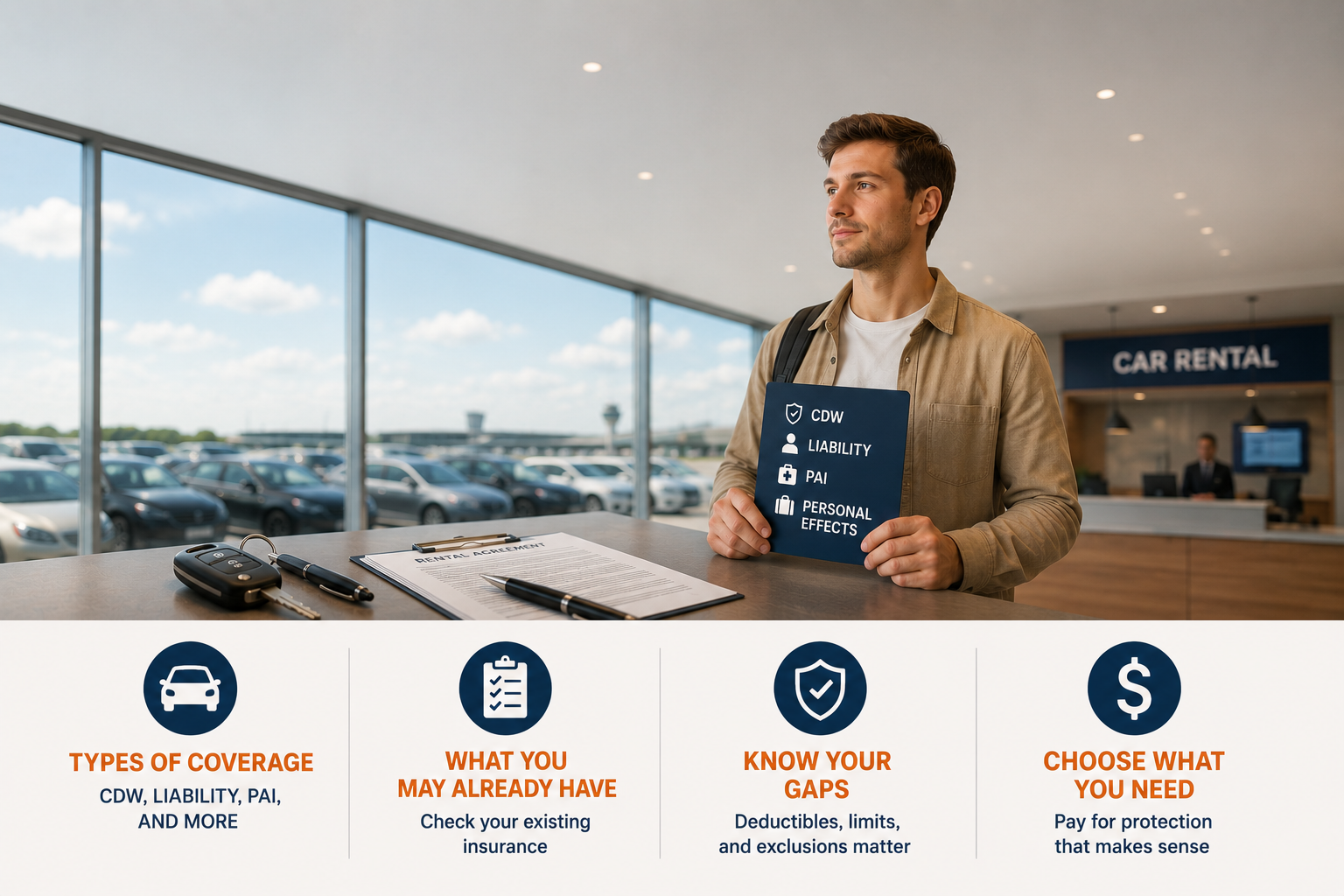
«Rental car insurance» is a general term for several different products. At the rental counter, you may be offered a collision or loss damage waiver, supplemental liability insurance, personal accident insurance, and personal effects coverage. These products do not protect against the same risks.
You may already have some protection through your personal auto policy, health insurance, homeowners or renters insurance, or an eligible credit card. However, existing coverage may have deductibles, territorial limits, excluded vehicle types, claim requirements, or gaps such as loss-of-use and administrative charges.
WHAT IS RENTAL CAR INSURANCE IN THE U.S.?
Before accepting or declining any rental company product, identify four things: what protection is included in the rental rate, what your existing policies cover, how much you could be required to pay after a loss, and whether the rental will be used only for permitted personal use.
The information below applies to personal-use car rentals in the United States. It does not address fleet, commercial, delivery, or for-hire rental arrangements.
Main Types of Rental Car Protection
Rental protection terms vary by rental company, pickup location, state, and selected package. Before signing the agreement, check what is included in the quoted rate, which products are optional, what deductible or financial responsibility remains, and which uses or types of damage are excluded.Collision and Theft Protection: CDW and LDW
Collision Damage Waiver (CDW) or Loss Damage Waiver (LDW) may reduce or waive the renter’s contractual responsibility for covered damage to, or theft of, the rental vehicle. It is generally a waiver offered under the rental agreement rather than standard auto insurance. Its effect depends on the selected package, any deductible or retained responsibility, listed exclusions, and compliance with the agreement. Depending on the rental agreement, CDW or LDW may address covered repair costs and theft-related losses. Towing, loss-of-use charges, diminished value, administrative fees, glass, tires, wheels, the roof, and undercarriage may be included, limited, or excluded. Some products waive most covered charges, while others leave the renter responsible for a stated amount. CDW or LDW should not automatically be interpreted as «zero out-of-pocket cost.» Check whether the agreement leaves you responsible for a deductible, excluded vehicle parts, unauthorized use, loss-of-use charges, administrative fees, or damage that results from violating the rental terms. Exact exclusions vary by rental company and protection package. Common items to verify include:- Glass, mirrors, lights, tires, and wheels
- Roof, undercarriage, or interior damage
- Lost keys, lockouts, or misfueling
- Unauthorized drivers
- Driving outside the permitted territory
- Off-road or prohibited use
- Reckless driving or driving under the influence
- Damage reported outside the required claim procedure
Liability and Injury Coverage: SLI and PAI
Supplemental Liability Insurance (SLI) may increase the liability protection available for covered bodily injury or property damage claims made by other people. It does not cover damage to the rental vehicle itself. The amount of liability protection already included with a U.S. rental varies by state, rental company, and agreement. Do not assume that the minimum protection supplied with the rental matches the limits on your personal auto policy. Before purchasing SLI, check:- the bodily injury and property damage limits already available;
- whether your personal auto liability coverage extends to the rental;
- whether SLI is primary or excess over other applicable insurance;
- whether the stated limit includes or sits above the underlying protection;
- excluded drivers, prohibited uses, and territorial restrictions.
Personal Effects Coverage (PEC): Protecting Belongings in the Cabin
What is PEC? Personal Effects Coverage (PEC) may cover specified personal belongings stolen from the rental vehicle, subject to an aggregate limit, per-item limits, exclusions, and claim documentation requirements. The available limits vary by rental company and product. What PEC May Cover:- luggage, clothing, and other eligible personal property stolen from the rental vehicle;
- specified electronics, subject to per-item and aggregate limits;
- property belonging to covered passengers, if the policy includes them.
- cash, jewelry, collectibles, and other high-value property;
- items left in an unlocked vehicle or without evidence of theft;
- business equipment or property exceeding the per-item limit;
- losses not supported by a required police report or proof of ownership;
- property recoverable under another applicable policy.
- You don’t have homeowners/renters insurance or travel insurance with baggage coverage.
- You prefer a separate rental-company product after comparing its cost, deductible, limits, and exclusions with your existing property coverage.
- Report the theft to local law enforcement as soon as possible when required by law, the rental agreement, or the applicable coverage terms.
- Notify the rental company and coverage provider as soon as possible and within the deadlines stated in the rental agreement and policy.
- Provide receipts or proof of ownership for stolen items, photos of forced entry or damage, and any other documentation requested.
Rental Car Protection Comparison
Coverage Summary Table
| Product | Main risk addressed | Does not normally replace | What to verify |
|---|---|---|---|
| CDW or LDW | Contractual responsibility for covered damage to or theft of the rental vehicle | Liability for injuries or damage to other people | Remaining responsibility, excluded parts, loss of use, and administrative fees |
| SLI | Covered bodily injury and property damage claims made by third parties | Damage to the rental vehicle | Available base limit, total SLI limit, and primary or excess status |
| PAI | Defined accident benefits for covered occupants | Full health insurance or liability coverage | Covered persons, benefit limits, exclusions, and duplicate coverage |
| Personal Effects Coverage | Theft of specified personal belongings | Damage to the rental vehicle or third-party liability | Per-item limits, aggregate limit, deductible, and proof requirements |
Coverage You May Already Have
Personal Auto Insurance
A personal auto policy may extend some liability, collision, and comprehensive coverage to a rental vehicle used for personal purposes in the United States. The scope of protection depends on the policy, state rules, vehicle type, and circumstances of the rental. Before declining the rental company’s CDW or LDW, ask your insurer:- whether liability coverage extends to the rental;
- whether collision and comprehensive coverage apply;
- which deductible would apply;
- whether loss of use, diminished value, towing, storage, and administrative fees are covered;
- whether the vehicle class or value creates a limitation;
- whether every planned driver is covered;
- whether delivery, rideshare, or other business use is excluded.
Credit Card Rental Benefits
Some credit cards include a rental vehicle damage or theft benefit when an eligible rental is paid for with the card. The card network name or card tier alone does not confirm that the benefit is included. Read the current Guide to Benefits for your exact card account. Verify:- whether the benefit is primary or secondary;
- whether you must decline the rental company’s CDW or LDW;
- whether the full rental cost must be charged to the card;
- whether additional drivers are covered;
- which vehicle types are excluded;
- the maximum eligible rental period;
- whether loss of use, towing, and administrative fees are covered;
- how quickly an incident must be reported;
- which documents are required for a claim.
Third-Party Rental Car Protection
Independent rental vehicle protection may be available through a travel insurer or specialized provider. These products are not automatically equivalent to the rental company’s CDW or LDW. Some third-party policies use a reimbursement model. After a covered loss, the rental company may charge the renter first, and the renter must then submit a separate claim for reimbursement. This can require sufficient available credit or cash while the claim is reviewed. Before purchasing a third-party product, verify:- whether the policy is available in your state;
- whether it covers the full value of the rental vehicle or only a deductible;
- whether it includes theft, loss of use, towing, administrative fees, glass, tires, keys, and undercarriage damage;
- whether luxury vehicles, trucks, vans, or long-term rentals are excluded;
- whether liability coverage is included;
- whether the rental company must be paid before reimbursement;
- which police reports, photographs, receipts, and rental documents are required.
What to Do After an Accident or Theft with a Rental
If an accident, theft, vandalism, or other loss occurs, follow the rental agreement and every applicable insurance or card-benefit reporting requirement. Do not assume that all providers use the same deadline.At the scene
- Move to a safe location when possible and call emergency services if anyone is injured.
- Follow state law concerning police reports and information exchange.
- Photograph the vehicles, license plates, road conditions, damage, and relevant signs or signals.
- Collect the other driver’s name, contact information, vehicle information, and insurance details.
- Avoid speculating about fault. Provide accurate factual information.
Notify the rental company
Contact the rental company as soon as it is safe to do so. Use the emergency or claims number in the rental agreement and request written instructions. Ask whether the vehicle may be driven, where it should be returned or towed, and which incident forms are required.Notify every applicable coverage provider
If you may rely on a personal auto policy, credit card benefit, travel policy, or third-party rental protection, notify each provider within its stated deadline. One provider’s notification does not automatically satisfy another provider’s requirements.Keep copies of
- the rental agreement;
- the vehicle inspection report;
- photographs and videos;
- the police report or incident number, when applicable;
- towing and storage receipts;
- the rental company’s damage report and repair estimate;
- correspondence with the rental company and insurers;
- claim reference numbers.
Mistakes That Can Jeopardize a Claim
A claim may be delayed, limited, or denied if the renter uses an unauthorized driver, violates territorial or use restrictions, misses a reporting deadline, fails to obtain a required report, provides incomplete documentation, or continues driving an unsafe vehicle. The consequence depends on the agreement, policy, and facts of the incident.Checklist Before You Accept or Decline Rental Car Coverage
- Read the rental agreement for permitted drivers, territory, prohibited use, reporting duties, and damage charges.
- Check what liability and vehicle damage protection is already included in the quoted rate.
- Ask your auto insurer whether liability, collision, and comprehensive coverage extend to the rental.
- Confirm the deductible and whether loss of use, diminished value, administrative fees, towing, and storage are covered.
- Read the current Guide to Benefits for the exact credit card you will use.
- Confirm whether the card benefit is primary or secondary and whether declining CDW or LDW is required.
- Check excluded vehicle types and the maximum eligible rental period.
- Determine whether a third-party policy pays the rental company directly or reimburses you after you pay.
- Make sure every driver is authorized under the rental agreement.
- Inspect and photograph the vehicle before leaving the rental location.
- Save the agreement, inspection report, policy documents, benefit guide, and claim contact information.
- Confirm that the vehicle will be used only for purposes permitted by the agreement and applicable coverage.
Quick Decision Guide for U.S. Rentals
You have personal auto insurance with collision and comprehensive
Ask whether it extends to the rental, which deductible applies, and whether loss of use, diminished value, and administrative fees are covered. Compare those terms with the rental company’s CDW or LDW.You have a credit card with a rental benefit
Read the current Guide to Benefits. Confirm that the rental, vehicle, driver, duration, and payment method are eligible. Do not assume the benefit includes third-party liability.You do not carry personal auto insurance
Determine what liability protection is included in the rental and review the rental company’s vehicle damage waiver. A credit card benefit may cover eligible damage to the rental vehicle but normally should not be treated as liability insurance.You are concerned about medical expenses
Compare PAI with your health insurance, MedPay or PIP coverage, and any travel or accident policy.You are concerned about belongings in the vehicle
Compare PEC with off-premises coverage under homeowners, renters, or travel insurance.You plan to use the vehicle for delivery, rideshare, or other paid work
Stop and confirm that the rental agreement and insurance expressly permit commercial or for-hire use.Comparison Table: Counter vs. Card vs. Third-Party vs. Personal Policy
| Coverage source | What it may provide | Main limitation | Document to check |
|---|---|---|---|
| Rental company CDW or LDW | May reduce contractual responsibility for covered damage to or theft of the rental vehicle | May contain exclusions and does not normally replace third-party liability coverage | Rental agreement and waiver terms |
| Rental company SLI | May provide additional protection for covered third-party liability claims | The limit and relationship to underlying coverage vary | SLI policy or coverage summary |
| Personal auto policy | Liability, collision, and comprehensive coverage may extend to a personal-use rental | Deductibles, exclusions, state rules, and claim consequences apply | Auto policy and written insurer confirmation |
| Credit card benefit | May cover eligible damage to or theft of the rental vehicle | May be primary or secondary and normally does not replace liability coverage | Current Guide to Benefits |
| Third-party rental policy | May reimburse eligible rental vehicle damage charges | The renter may have to pay first, and exclusions vary | Insurance policy and claim terms |
| Health insurance or PAI | May address specified medical expenses or accident benefits | Does not cover damage to the rental vehicle or third-party liability by itself | Health plan documents or PAI certificate |
| Homeowners, renters, or PEC | May address theft of eligible personal belongings | Deductibles, per-item limits, aggregate limits, and exclusions apply | Property policy or PEC terms |
FAQ
You may be able to decline the rental company’s CDW or LDW if your exact card benefit covers the rental and requires or permits you to decline the waiver. Confirm the eligible vehicle type, rental period, payment method, authorized drivers, exclusions, and claim process before making that decision.
PAI may overlap with health insurance, MedPay, PIP, travel insurance, or accidental death coverage, but the benefits are not necessarily identical. Compare the covered persons, benefit limits, deductibles, exclusions, and payment method before deciding.
It may. Some card benefits require you to decline the rental company’s CDW or LDW. Purchasing the waiver may therefore make the card benefit unavailable for that rental. Check the current Guide to Benefits before accepting coverage at the counter.
No. SLI addresses covered third-party bodily injury or property damage claims. Damage to the rental vehicle is addressed separately through CDW or LDW, applicable personal auto coverage, an eligible credit card benefit, or another qualifying policy.
It depends on the exact card benefit. Check whether the current Guide to Benefits expressly includes loss-of-use charges and what documents the administrator requires from the rental company.
Check the off-premises or personal property section of your policy. Coverage may apply subject to a deductible, per-item limits, excluded property, claim documentation requirements, and any off-premises coverage limit. Confirm the terms with your insurer before relying on the policy.
CAR
INSURANCE
FOR
17-YEAR-OLDS:
COSTS, LEGAL OPTIONS,
AND THE CHEAPEST
WAY
TO GET COVERED
- Can a 17-year-old buy car insurance alone? In many cases, not easily. A 17-year-old often needs a parent, guardian, or another adult involved because contract rules for minors and insurer underwriting requirements can limit independent purchase. The exact setup depends on state law and the insurance company.
- Cheapest setup? In most cases, staying on a parent’s existing policy is still the cheapest starting point. After that, the biggest savings usually come from telematics, good-student eligibility, and choosing a lower-risk vehicle.
- Typical cost at 17? Insurance at 17 is usually expensive, especially for full coverage. National averages can help set expectations, but the real quote will depend heavily on the household policy, vehicle, address, and insurer.
- Must you list a permit holder? Usually yes. Insurers typically require teens with learner’s permits to be listed on household policies. — Zacks, 2024.
WHAT IT COSTS AT 17: AVERAGES AND WHEN RATES DROP
Typical premiums and when they decline
Insurance is usually expensive at 17 because the driver has limited experience and a short rating history. Rates often improve over time, but the first meaningful savings usually come from staying claim-free, using the right vehicle, and keeping the policy structure clean — not from age alone.What drives the price most
The price usually moves the most based on four things: who the teen is insured with, what car is being insured, where the car is kept, and how much liability protection is chosen. For most families, the biggest mistake is focusing only on the teen’s age while ignoring the vehicle, the garaging address, or the difference between a parent policy and a separate policy.Add to Parent vs Separate Policy: Choose the Right Setup
Which is cheaper and exceptions
For most 17-year-olds, the lowest-cost setup is still being added to a parent or guardian’s existing policy instead of buying separate coverage. That is usually where the household can keep multi-car, bundling, and tenure-based pricing advantages. A separate policy becomes more realistic only when ownership, garaging, household driving history, or underwriting rules make the family policy a poor fit. A separate policy may make more sense when the parent has a poor driving record, when the car is titled only to the teen, or when the vehicle is kept at a different address than the household policy shows. Those situations can change underwriting enough that the «cheap parent policy» assumption stops being true.Requirements and pitfalls
Before buying or titling the car, check whether the insurer will allow that vehicle on the household policy. Some insurers are comfortable when the car is titled to the parent or jointly. Others may require a separate policy if the vehicle is titled only to the teen. If you ignore that step, you can end up with the wrong policy structure from day one. The address where the car is actually kept matters more than many families expect. If the teen lives part-time somewhere else or the vehicle is regularly parked away from the household address, that can change underwriting and sometimes force a different policy setup. Check that before you buy the car, not after.| Scenario | Usually cheaper setup | Why | What to verify |
|---|---|---|---|
| Standard household | Add to parent’s policy | Household pricing advantages often make this the lower-cost option. | Confirm the teen lives at the same address and the vehicle can stay on the household policy. |
| Parent with poor driving history | Separate policy may be worth comparing | The parent’s record can make the household policy much more expensive. | Compare both setups and check whether the parent’s history is driving the quote up. |
| Vehicle titled only to the teen | Separate policy is often more realistic | Some insurers will not keep that vehicle on the parent’s policy. | Check ownership rules before buying or titling the car. |
| Car kept at a different address | Separate policy may be required | The actual garaging location can change underwriting and eligibility. | Verify where the vehicle is kept most of the time and how the insurer wants it listed. |
| Low-risk vehicle and strong household profile | Add to parent’s policy | A safer vehicle and a clean household record often support better pricing. | Make sure the vehicle, drivers, and garaging details all match the application. |
| Teen needs separate underwriting review | Separate policy | Ownership, address, or driver setup may not fit the household policy. | Confirm whether the insurer accepts the teen, the vehicle, and the address under one policy. |
Pay Less Today: Discounts, Telematics, Car and Coverage Tweaks
Discounts and programs that move the needle
If the goal is to lower the price quickly, focus on the discounts that usually matter most first: telematics, good-student eligibility, and staying on an existing household policy when possible. Smaller items like paperless billing or autopay may help a little, but they do not usually change the quote as much as the policy structure, vehicle choice, or driving-score programs. Do not assume discounts stack neatly in a predictable order. Insurers calculate them differently, and some discounts may not combine the way consumers expect. The practical move is to request quotes both with and without telematics, confirm good-student eligibility, and compare the final premium rather than relying on generic savings examples. Some insurers offer student-related discounts when the teen studies away from home and does not keep regular access to the vehicle. Eligibility rules vary, so treat this as a possible extra — not as a core savings strategy. Required documentation by discount:- Good student: GPA transcript or report card (B average or better).
- Driver’s education: certificate of completion.
- Telematics: app download/device installation; consistent data transmission.
- Distant student: school enrollment verification, proof of garaging at family residence.
Car, coverage, deductibles—what to change safely
Choose a vehicle that is cheaper to repair, less likely to be stolen, and less likely to be rated as a performance risk. For teen drivers, the wrong car choice can push the premium up fast, even before coverage selections are adjusted. The cheapest quote is not always the safer choice. Cutting liability down to the state minimum may save money upfront, but it can leave the household badly exposed after a serious at-fault crash. A better approach is to compare at least two versions of the quote — one near the minimum and one with meaningfully stronger liability limits — and see how much real premium difference there is. Common mistake: Cutting liability limits to state minimums to save premium, exposing the household to significant personal liability in a serious at-fault accident.How to Compare Coverage at 17 Without Relying on State Minimums
Minimums vs stronger protection
State minimum liability limits are often insufficient for real-world injury and property damage costs. Teens face high-severity risk due to inexperience. A single at-fault accident involving serious injuries can generate claims far exceeding state minimums. For most families, the better question is not «What is the one right coverage setup?» but «How much extra protection do we get for the added premium?» That comparison matters more than copying a generic recommendation, especially when state rules, vehicle value, household finances, and insurer underwriting can differ so much.How to compare quote versions in practice
State minimum coverage may be enough to drive legally, but it may not be enough to absorb the financial damage from a serious crash. That matters even more for teen drivers because one early at-fault accident can create a large liability problem for the household. Instead of copying a generic coverage matrix, compare quotes in versions. Look at how the premium changes when liability protection is increased, when deductibles are adjusted, and when coverages such as UM/UIM, collision, or comprehensive are added or removed. That gives a more realistic decision than relying on one universal set of limits.NY Quick Facts: Requirements and Local Context
NY quick facts
If the policy is being written in New York, do not rely on generic national advice alone. New York has its own minimum liability requirements, no-fault rules, and insurer procedures. For teen drivers, especially minors, permit holders, or households with unusual ownership or garaging arrangements, the safest move is to verify current rules directly with NY DFS, NY DMV, and the insurer before binding coverage.Step-by-Step: How to Get Insured at 17
If joining a parent/guardian policy
If the teen is joining a household policy, start by confirming three basics: who owns the car, where it is actually kept, and whether the permit holder or licensed teen must be listed now. Those details affect both price and underwriting, and getting them wrong early can create bigger problems later. Once the vehicle and policy structure make sense, compare the quote in more than one coverage version and confirm the effective date before the teen drives alone. After that, finalize billing, make sure the teen is correctly listed, and keep proof of insurance ready for the vehicle.Steps
- Confirm the policy can legally and practically fit the teen, the vehicle, and the garaging address.
- Compare quotes in more than one coverage version, not just by headline price.
- Bind coverage only after discounts, listed drivers, and effective date are confirmed in writing.
If standalone with an adult co-signer
If a separate policy is the only realistic option, check three things before moving forward: whether the insurer accepts that setup for a minor, whether the vehicle title and garaging address fit the application, and whether the final premium still makes sense compared with staying on a household policy. Separate coverage can solve a policy-fit problem, but it often stops being the lower-cost option.Steps
- Verify co-signer requirements and state rules regarding minor policyholders. Confirm that the co-signer meets the insurer’s eligibility criteria.
- Choose an insurable, low-risk vehicle. Set higher deductibles if needed to manage premium. Enroll in telematics if the insurer offers usage-based pricing.
- Bind the policy. Schedule telematics device installation or mobile app activation. Plan to re-shop at 6 to 12 months of clean driving to compare rates and potentially transition to a lower-cost option.
Documents and Common Errors Checklist
Most teen-policy problems do not start with complicated legal issues. They start with bad details: the wrong garaging address, a missing household driver, a title mismatch, or discount paperwork that does not match the application. That is why the review step matters before the policy is bound. Before you bind:- Match names on license, vehicle title, and policy application.
- Confirm VIN accuracy.
- Verify garaging address matches where vehicle is kept most of the time.
- List all household drivers (including permit holders).
- Submit required documents for discounts (GPA transcript, driver’s ed certificate).
- Review coverage selections and ensure lienholders are satisfied (if financed).
- Mismatch between garaging address and actual vehicle location.
- Failure to disclose all household drivers.
- Incomplete or expired driver’s education certificates.
- VIN errors.
- Insufficient proof of good student status.
When It Makes Sense to Compare Quotes Again
Re-shop the policy after a clean renewal period, after the teen moves from permit to licensed driving, after a vehicle change, or when a meaningful discount becomes available that was not on the original policy. In practice, the first smart re-check is often around the first renewal rather than on an arbitrary age milestone.Common mistakes that make teen insurance harder or more expensive
Families often overfocus on the teen’s age and underfocus on the details that actually change underwriting. The most common mistakes are buying the car before checking policy fit, using the wrong garaging address, failing to disclose all household drivers, and chasing the lowest quote without comparing liability protection.FAQ
A non-owner policy may be available in some cases, but it is not the standard solution for most 17-year-olds. It usually makes sense only when the teen does not own a car, does not have regular access to one household vehicle, and still needs liability coverage for occasional driving. Eligibility depends heavily on the insurer and state-specific rules.
Paying in full can reduce total cost with some insurers, but the real benefit varies. What matters is not only whether there is a pay-in-full discount, but also whether monthly billing adds service fees, financing charges, or other costs that make installment payments more expensive overall.
A 17-year-old may be able to own a vehicle, but ownership and insurance eligibility are not the same issue. Even when a teen can hold title, the insurer may still require a different policy structure, an adult’s involvement, or a separate underwriting review.
A learner’s permit typically requires the teen to be listed on the household insurance policy. Most insurers require disclosure of all household drivers, including those with learner’s permits. Insurers generally require learner’s permit holders to be disclosed and listed on household policies. — Zacks, 2024. The teen is usually covered under the household policy while driving with a licensed adult. Once the teen obtains a full license, the insurer may adjust the rating to reflect the teen’s independent driving exposure. Check state law and insurer requirements to confirm permit-holder listing and coverage.