

Автор: admin
UBER INSURANCE WHAT INSURANCE DO YOU NEED TO DRIVE FOR UBER?

UNDERSTANDING UBER’S PROVIDED INSURANCE COVERAGE
Coverage by driver status
Offline: Your personal auto policy applies. Uber’s coverage is not active. If you have a claim during this period, your personal insurer reviews it under your policy terms. Uber’s platform coverage changes by driver status, but drivers should not rely on generic internet numbers as the final answer for their situation. The practical point is simpler: when you are offline, your own policy controls; when the app is on, coverage can shift; and when a trip is active, Uber’s platform coverage is broader than it is during waiting time. The detail that matters most is not memorizing a national summary number, but understanding whether your own policy, endorsement, deductible structure, and vehicle use line up with that platform coverage. On trip (accepted request through drop-off, Periods 2 and 3): Platform coverage is generally broader during an active trip than it is while waiting for a request, but drivers still need to understand how their own policy, deductible structure, and physical damage coverage interact with that protection. The important question is not whether a generic national number sounds high enough, but whether the policy setup actually works for the vehicle and the driver’s use case.Key gaps and conditions
Uber’s policy is designed for the platform. Your personal policy terms still matter. Collision and comprehensive coverage while on trip are often contingent on your own policy having those coverages. Some losses — such as damage to personal items, certain fees, or specific types of accidents — may be excluded. Review your policy documents to understand when liability, collision, and comprehensive coverage triggers, what limits apply, and what deductibles you will owe. The gap that catches many drivers is the time when the app is on but no trip has started yet. That is the point where a standard personal policy may not respond the way a driver expects, while platform coverage may still be limited. In practice, this is why a rideshare endorsement or a properly structured hybrid policy matters: not because it sounds better on paper, but because it can reduce the mismatch between how the car is actually being used and how the risk is insured. NYC TLC drivers: If you operate under a TLC license in NYC, Uber’s coverage supplements — but does not replace — your TLC-required commercial liability policy. You must maintain a TLC-compliant policy with the minimum liability limits mandated by the TLC, and file the FH-1 form. Uber’s platform coverage does not satisfy the TLC’s insurance requirements on its own.|
Driver Status |
Whose Policy Applies |
Liability Coverage |
Collision Coverage |
Comprehensive Coverage |
Notes and Conditions |
|---|---|---|---|---|---|
|
Offline |
Personal policy |
Per personal policy terms |
Per personal policy terms |
Per personal policy terms |
Uber coverage is not active; personal policy may exclude rideshare use if no endorsement |
|
Waiting for request (Period 1) |
Uber policy (limited) |
Uber provides third-party liability |
Generally not covered by Uber |
Generally not covered by Uber |
Personal policy may deny claim if it excludes commercial use; endorsement or hybrid policy recommended |
|
On trip (Periods 2 and 3) |
Uber policy (primary) |
Uber provides primary liability |
Contingent on personal policy coverage |
Contingent on personal policy coverage |
Deductible obligations may still apply, and contingent physical damage coverage depends on how the driver’s own policy is structured |


NYC (TLC) vs. Rest of New York: What You Need and What Documents Are Required
If you drive in New York City (under TLC jurisdiction)
NYC rideshare drivers must comply with TLC regulations. A personal auto policy with a rideshare endorsement is not sufficient. You must:- Obtain a TLC-compliant commercial auto insurance policy that meets TLC minimum liability limits (verify current limits at NYC TLC Insurance Requirements).
- File an FH-1 certificate with the TLC. This certificate is issued by your insurance carrier and proves that your policy meets TLC standards. Your insurer must be licensed to provide TLC coverage in NYC.
- Maintain coverage continuously and update the TLC if you change insurers or policies.
- Driver’s license (valid NYS license with appropriate class)
- Vehicle registration (NYS registration)
- TLC license number (if you already have one)
- VIN (vehicle identification number)
- Garaging address in NYC
- Prior insurance history (declarations page from your current policy, if applicable)
- Proof of TLC vehicle inspection (if required)
- Insurer not authorized to file FH-1 in NYC
- Policy limits below TLC minimums
- Policy does not name the TLC as a certificate holder
- Gaps in coverage dates
- Vehicle not listed on the policy or VIN mismatch
- NYC TLC Insurance Requirements
- NYC TLC FH-1 Information
If you drive outside NYC (rest of New York State)
Outside NYC, you are not subject to TLC regulations. You must:- Maintain a valid personal auto insurance policy that meets New York State minimum liability requirements.
- Add a rideshare endorsement to your personal policy, or obtain a hybrid rideshare policy. This extends your personal coverage to include rideshare activity and closes the Period 1 gap.
- Verify that your insurer offers rideshare endorsements in New York State. Not all carriers offer this coverage.
- Driver’s license (valid NYS license)
- Vehicle registration (NYS registration)
- VIN
- Garaging address
- Driving history (MVR or claims history may be reviewed)
- Current policy declarations page (if switching insurers)
- Confirmation that you will drive for Uber (and other platforms, if applicable)
Decision guide: Which coverage do you need?
- If you drive in NYC and have a TLC license: TLC-compliant commercial policy + FH-1. A personal policy with endorsement is not acceptable.
- If you drive outside NYC (e.g., Buffalo, Rochester, Albany, Long Island but not within TLC jurisdiction): Personal policy + rideshare endorsement, or hybrid rideshare policy.
- If you drive both in and out of NYC: You must maintain the TLC-compliant commercial policy for NYC driving. Consult your insurer about whether that policy covers you adequately outside NYC, or if you need separate coverage.
What this usually means in practice
What this usually means in practice is simple. A part-time driver outside NYC may be able to use a personal policy with a rideshare endorsement if the carrier allows that use. A driver operating under TLC rules in NYC usually needs a different policy structure entirely. A driver who also does delivery work should not assume the same endorsement automatically covers every platform. And a driver using a borrowed or rental vehicle should confirm eligibility before relying on the vehicle for paid driving at all.Why Your Personal Policy Isn’t Enough: The Need for Rideshare Insurance
A personal auto policy is built around private driving, not app-based passenger work. The real problem is not just that rideshare use may be excluded, but that many drivers assume the policy will still work normally once they go online. That assumption is where expensive mistakes begin. If your coverage does not match how the vehicle is actually being used, a claim can become slower, narrower, or more disputed than you expected. The point of rideshare coverage is not to make the policy sound more complete. It is to reduce the gap between real use and insured use.Types of Rideshare Insurance Policies
Choose a rideshare policy that matches your driving pattern, vehicle use, and budget. Compare coverage, limits, deductibles, and insurer requirements before you decide. Rideshare endorsement: An add-on to your personal auto policy that extends coverage for rideshare use. It typically closes the Period 1 gap by providing collision and comprehensive coverage when you are waiting for a request. Not all insurers offer the same rideshare structure, and some carriers separate passenger work, delivery work, and commercial use more strictly than drivers expect. Before choosing an endorsement, confirm exactly what activities it covers. Hybrid policy: A combined personal–rideshare policy that aligns coverage for private driving and rideshare activity. It simplifies claims and limits by treating both uses under one policy. Hybrid policies may offer more consistent deductibles and limits across all driver statuses. They are useful for drivers who spend significant time online and want streamlined coverage. Full commercial insurance: A business-grade auto policy offering the broadest coverage for frequent or multi-platform drivers. Commercial insurance is sometimes required for certain vehicle types, fleet operators, or drivers who also work with taxi, livery, or delivery services (e.g., TLC drivers in NYC). It provides primary coverage regardless of trip status and may be necessary if you operate a transportation business. These options differ by insurer, state, and market. Ask your broker to compare coverage terms, limits, deductibles, exclusions, and documentation requirements. Do not assume one option is universally better. The correct choice depends on your actual vehicle use, driving frequency, income reliance, and risk tolerance.|
Policy Type |
For Whom |
Uber/TLC Acceptable? |
Coverage Highlights |
Notes |
|---|---|---|---|---|
|
Rideshare Endorsement |
Part-time or occasional drivers outside NYC who want to keep a personal-policy structure |
Yes for Uber outside NYC; No for TLC in NYC |
Extends a personal policy to better align with app-on rideshare use, especially around the waiting-for-request stage |
Useful when the carrier allows rideshare use under a personal-policy structure; does not satisfy TLC requirements in NYC |
|
Hybrid Rideshare Policy |
Drivers outside NYC who want one policy structure for both personal and rideshare use |
Yes for Uber outside NYC; No for TLC in NYC |
Combines personal and rideshare use in a single policy structure, which may simplify claims handling and deductible logic |
Useful for drivers who want one policy structure for personal and rideshare use; availability varies by carrier |
|
Commercial/TLC Policy |
NYC TLC drivers and drivers operating in a more commercial use model |
Yes for TLC in NYC; may also be used for Uber depending on the operating setup |
Primary commercial-style coverage designed for for-hire or more business-oriented vehicle use |
Required for TLC driving in NYC and may be appropriate when the vehicle is used in a more commercial operating model |
How to Get the Right Coverage Without Creating a Claim Problem Later
Step 1: Determine your coverage needs
- NYC TLC driver: You need a TLC-compliant commercial policy and FH-1.
- Outside NYC, regular Uber driver: You need a personal policy with a rideshare endorsement or a hybrid rideshare policy.
- Multi-platform or delivery: Verify that your endorsement or policy covers Uber, Lyft, Uber Eats, DoorDash, or other platforms you use.
Step 2: Gather required information for your insurance quote
Prepare the following before contacting an insurer or broker:- Driver’s license: Valid New York State driver’s license (number, expiration, class)
- Vehicle identification number (VIN): For the vehicle(s) you will use for Uber
- Vehicle registration: Current NYS registration
- Garaging address: Where the vehicle is parked overnight (must be in NY)
- Driving history: Approximate years of driving experience; any accidents or violations in the past 3–5 years (insurers will pull an MVR)
- Current insurance policy: Declarations page from your existing policy (if switching insurers or adding endorsement)
- TLC license number (if applicable): For NYC drivers
Step 3: Request and compare quotes
- Contact your current insurer to ask whether they offer a rideshare endorsement or TLC-compliant commercial coverage in New York.
- If they do not offer the right structure, or if the quote does not fit your use case, speak with a licensed broker who works with New York rideshare drivers.
- Compare at least 2–3 quotes on the same basis so you are not comparing different deductibles, different physical damage terms, or different coverage structures.
Step 4: Select and purchase your policy
Before you commit, review how the policy describes your actual vehicle use. Confirm whether rideshare activity is covered at the right stage, whether delivery work is included if relevant, whether physical damage coverage is in place if you need it, and what happens when a claim may involve both your own policy and platform coverage.Step 5: Obtain proof of insurance and upload to Uber/TLC
For Uber (outside NYC):- Your insurer will issue an insurance ID card and a policy declarations page that shows coverage dates, limits, and vehicle information.
- Upload these documents in the Uber Driver app under the Insurance section.
- Uber reviews and verifies your insurance. If approved, you can go online. If rejected, Uber will notify you of the reason (e.g., coverage dates do not match, vehicle VIN mismatch, endorsement not shown).
- Your insurer will file the FH-1 certificate directly with the TLC.
- You will also receive a certificate of insurance for your records.
- Verify with TLC that the FH-1 is on file and accepted before you begin driving.
- Keep a copy of your FH-1 and policy documents in your vehicle.
- Coverage start date in the future or lapsed coverage
- VIN on the insurance document does not match the vehicle registered with Uber/TLC
- Policy does not show rideshare endorsement or TLC compliance
- Insurer not recognized or not authorized in New York
- Limits below Uber’s or TLC’s minimums
- Policy holder name does not match driver name
- Double-check that the VIN, driver name, and coverage dates match your Uber or TLC application exactly.
- Ensure your insurer explicitly states «rideshare» or «TNC» on the policy documents, or that the FH-1 is filed for TLC drivers.
- Upload clear, legible images or PDFs of all pages.
Step 6: Maintain continuous coverage and update as needed
- Renew your policy on time. Uber and TLC require continuous coverage. A lapse can result in deactivation.
- Notify Uber and TLC immediately if you change insurers or vehicles.
- Review your coverage annually or when your driving frequency changes.
Non-Owner, Rental, and Express Drive Scenarios
If you drive a borrowed, leased, or rental vehicle, do not assume the standard rideshare advice still applies without changes. Coverage can shift based on ownership, who is listed on the policy, what the rental agreement allows, and whether the platform has approved that vehicle setup. In these cases, drivers should confirm both platform eligibility and insurance structure before relying on the vehicle for Uber work.Delivery (Uber Eats, DoorDash): Coverage Basics
If you also do delivery work, do not assume it is treated the same way as passenger rides. Personal auto policies often exclude delivery for pay, and platform coverage may be limited or structured differently from rideshare coverage. Some insurers extend gig-use coverage across multiple platforms, while others separate rideshare and delivery exposure or require each activity to be specifically listed. The key question is whether your own policy structure matches every type of paid driving you actually do.Factors That Affect Your Rideshare Insurance Premium and Deductibles
Price is driven less by a single ‘rideshare surcharge’ and more by the overall risk profile: your driving history, vehicle, location, time on the road, and the policy structure you need. For many drivers, the most important cost decision is not the headline premium but the trade-off between deductible exposure, physical damage coverage, and whether the policy actually fits all of their gig activity.What to Do After an Accident While Driving for Uber
If an accident happens, protect safety first. Then report and document promptly to preserve claim rights under every policy — Uber’s and your own. Keep communications factual and consistent. Follow these steps:1) Ensure safety
Move to a safe area if the vehicle is drivable. Check for injuries among all parties. Call emergency services if anyone is injured or if there is significant property damage.2) Secure information
Collect contact information, driver’s license details, and insurance information from all parties involved. Obtain contact details from witnesses. Note the time, location, weather, road conditions, and vehicle details. Do not admit fault or make statements about liability at the scene.3) Document
Take photos and video of vehicle damage, the accident scene, traffic signs, road conditions, and any visible injuries. Save dashcam footage if your vehicle is equipped with one. Document the Uber app status — whether you were offline, waiting for a request, or on trip. Screenshot the app if possible.4) Report in the Uber app
Use the in-app accident report feature to notify Uber. Provide the required information and follow any instructions from Uber’s support team. Uber will begin their claim intake process.5) Contact your insurer
Notify your personal auto insurance carrier per your policy terms. Disclose that you were driving for Uber at the time of the accident. Failure to disclose rideshare activity may result in claim denial or policy cancellation.6) File the claim(s)
Submit required forms and evidence to both Uber’s insurance carrier and your own. Keep claim numbers, adjuster contact information, and copies of all submitted documents. If the accident occurred during Period 1 or if there is a coverage dispute, you may need to work with both insurers. If you are at fault and on trip, expect to pay Uber’s deductible. If your insurer offers a deductible bridge, they may cover the difference.7) Follow up
Track medical treatment, vehicle repairs, rental car arrangements, and all correspondence. Maintain a central log with dates, names, claim numbers, and summaries of conversations. Respond promptly to any requests for additional information or documentation.Your Insurance Checklist for Driving with Uber
Before your next trip, verify that your insurance coverage matches your actual vehicle use and Uber’s requirements. Use this checklist:- Personal auto policy is active: Confirm that your state-required personal auto insurance is current and in good standing.
- Rideshare endorsement, hybrid policy, or TLC-compliant commercial policy added: If you drive regularly for Uber outside NYC, add a rideshare endorsement or switch to a hybrid policy. If you drive in NYC under TLC, obtain a TLC-compliant commercial policy and file FH-1.
- Coverage structure fits your actual driving: Review not only limits, but also whether rideshare use, delivery work, deductibles, and physical damage coverage line up with how you actually use the vehicle.
- Uber policy terms for your market: Check Uber’s official insurance overview for your state or region. Verify liability limits, deductibles, and contingent coverage rules.
- Insurance documents stored in your phone: Save digital copies of your insurance ID card, policy declarations page, Uber’s insurance certificate, and claim contact information.
- Deductibles reviewed: Understand what deductible applies when platform coverage and your own policy interact, especially for physical damage claims.
- Vehicle modifications disclosed: If you have modified your vehicle, confirm that your insurer knows and that the modifications do not affect coverage.
- TLC drivers: FH-1 filed and accepted (NYC only): Verify that your FH-1 certificate is on file with the TLC and that your policy is current.
Common mistakes before a claim happens
- assuming a personal policy is enough once the app is on;
- buying a policy that works outside NYC but not under TLC rules;
- failing to confirm whether delivery work is covered too;
- uploading proof that does not match the vehicle or driver details;
- focusing on premium first and deductible structure second.
FAQ
COMPARE QUOTES CAR INSURANCE SIDE-BY-SIDE: FAST, ACCURATE METHOD

SIDE-BY-SIDE IN 5 MINUTES
Normalize your inputs before you compare
Any difference in the information you provide produces a different quote. Even small variations — rounded mileage, approximate commute distance, incomplete violation history — shift the insurer’s risk assessment and change the premium. Use the same information in every quote request: driver history, garaging address, annual mileage, vehicle details, ownership status, and any business or rideshare use. Small mismatches can change the premium enough to make the comparison misleading. If you quote one carrier at 8,000 miles a year and another at 12,000, you are no longer comparing the same risk.Driver & vehicle profile (use identical data)
Driver information: Full legal name, date of birth, driver’s license number and state, years licensed, marital status, education level (when requested), occupation (when requested), all accidents or claims within the past three to five years, all traffic violations within the past three to five years, credit tier or score (in states that permit credit-based insurance scoring), SR-22 filing requirement (yes or no). Vehicle information: Vehicle Identification Number (VIN) or exact year/make/model/trim, ownership status (owned outright, financed, or leased), garaging ZIP code and specific address, annual mileage estimate, commute distance and frequency (days per week), business use or rideshare activity (yes or no), factory-installed safety features (automatic emergency braking, lane-keeping assist, blind-spot monitoring), aftermarket anti-theft devices, eligibility for telematics or usage-based programs. Policy context: Current insurer name, months of continuous coverage without lapse, any lapse in coverage (number of days), prior liability and physical damage limits, desired effective date, preferred payment plan (monthly installments or pay-in-full discount). When any of these fields differ between quotes, the comparison becomes unreliable. A driver who reports 8,000 annual miles to one insurer and 12,000 to another receives quotes reflecting different risk levels. The same applies to rounding commute distance, omitting a minor violation, or entering an approximate garaging address instead of the exact ZIP+4.Coverage package to match across carriers
Standardizing coverages eliminates one of the biggest quote comparison mistakes: comparing a bare-bones policy from one insurer with a more complete package from another. To make quotes comparable, match the same liability limits, deductibles, and optional coverages across all carriers. If one quote includes rental reimbursement, glass coverage, or OEM parts and another does not, the lower premium may not reflect the better value. Core liability coverages: Bodily Injury liability limits (example: 100/300 means $100,000 per person, $300,000 per accident); Property Damage liability (example: $100,000); Uninsured Motorist and Underinsured Motorist limits (match or exceed liability limits where state law permits); Personal Injury Protection (PIP) or Medical Payments (MedPay) as required or available in your state. Physical damage coverages: Comprehensive coverage with selected deductible (example: $500); Collision coverage with selected deductible (example: $500); Full glass coverage option (zero-deductible glass repair or replacement, if offered separately); OEM parts option (original manufacturer parts instead of aftermarket parts); New car replacement or gap coverage (when vehicle is financed, leased, or eligible by age). Optional add-ons: Rental reimbursement (daily dollar limit and maximum number of days — example: $40/day for 30 days); Roadside assistance or towing (per-occurrence limit); GAP insurance (when vehicle loan or lease exceeds Actual Cash Value); Rideshare or delivery endorsement (when applicable). Policy term and structure: Six-month versus twelve-month policy term; effective date (use the same date for all quotes); additional drivers to be listed or excluded; any driver exclusions required by state or insurer. Recording every limit, deductible, and add-on as exact numbers prevents apples-to-oranges comparisons. A quote with a $250 collision deductible is not directly comparable to one with a $1,000 deductible unless you account for how much more you would pay yourself after a claim.Evaluate true cost and protection (not just price)
Premium is only one part of what you pay. The other part—deductibles, uncovered expenses, and claim service quality—determines your total cost when something goes wrong.Out-of-pocket math you can trust
A practical quote comparison should include both the premium and the amount you could be forced to pay yourself after a claim. That usually means looking at the deductible, any excluded items, rental limits, parts restrictions, and other gaps that may not be obvious in the advertised price. Simple comparison rule: look at the annual premium, the deductible, and any costs the policy may leave you to cover yourself, such as rental overages, glass exclusions, or non-OEM parts differences. The quoted premium is not always the full amount you will pay. Before you choose a policy, check for installment fees, policy fees, SR-22 filing fees, cancellation penalties, and endorsements that can change the total cost. A quote can look cheap at first glance but become less attractive once those extra charges are included. Test the quote against a few common claim scenarios: Minor collision (fender-bender): Average repair estimate $1,850. — Insurance Information Institute, «Auto Insurance Claims Data» (2023). https://www.iii.org Add your annual premium to your collision deductible. If the insurer limits OEM parts or requires aftermarket bumpers, estimate the additional out-of-pocket difference. Comprehensive event (glass or hail): Costs vary widely by vehicle, parts availability, glass technology, and the severity of the damage. Instead of relying on a generic average, compare whether the quote includes full glass coverage, how the deductible applies, and whether parts restrictions could change your out-of-pocket cost. Total loss: Your payout equals the vehicle’s Actual Cash Value minus your deductible. If you owe more than the vehicle is worth, GAP coverage pays the difference. Without GAP, the uncovered amount comes out of your pocket. A higher deductible may lower your premium, but the trade-off is not always worth it. If the savings are small and you end up filing a claim, the extra out-of-pocket cost can easily outweigh the premium difference. Compare the deductible increase against the annual savings instead of assuming the higher deductible is automatically the smarter option.Company quality and claim experience
Once you have matched the coverage and compared likely out-of-pocket costs, use insurer quality as a tie-breaker, not as a substitute for comparing the policy itself. Financial strength: AM Best rates insurers from D (poor) to A++ (superior). An A or A+ rating confirms the company can pay claims during a large-scale catastrophe. — AM Best, «Financial Strength Ratings» (2023). https://www.ambest.com/ratings/financial-strength-ratings/ Financial strength ratings can help as a tie-breaker, especially if you are comparing carriers you do not know well. In general, stronger ratings may indicate better claims-paying ability during large losses, but you should still compare the actual policy terms, deductibles, and exclusions before making a decision. Complaint frequency: The NAIC Complaint Index compares actual complaints to expected complaints for an insurer’s market share. An index above 1.0 means more complaints than expected. — NAIC, «Complaint Index Information» (2022). https://www.naic.org/cipr_topics/topic_complaint_index.htm Complaint data can be useful, but it should be read carefully. A brand may operate through different insurer entities, and complaint patterns can vary by state, reporting period, and line of business. Use complaint history as a supporting signal, not as the only reason to choose or reject a quote. Claims satisfaction: J.D. Power’s 2024 U.S. Auto Claims Satisfaction Study ranks insurers on a 1,000-point scale. — J.D. Power, «U.S. Auto Claims Satisfaction Study» (2024). https://www.jdpower.com/business/press-releases/2024-us-auto-claims-satisfaction-study Claims satisfaction studies can help when two quotes look similar on paper. Still, they work best as a tie-breaker after you confirm that the coverage, deductible structure, rental limits, and exclusions actually fit your needs. Red flags to watch:- Binding fees or cancellation fees not disclosed upfront
- Restrictive repair networks that exclude your preferred body shop
- Poor catastrophe response (delays processing claims after hurricanes, wildfires, or hailstorms)
- Slow claim communication or unclear repair procedures after the policy is bound
What usually makes one quote better than another
In real quote comparisons, the biggest differences are often not the advertised price but the parts many drivers overlook: liability limits, UM/UIM coverage, rental reimbursement, deductibles, and exclusions that only become obvious during a claim. A quote that looks $100 or $150 cheaper may still be the worse option if it shifts more risk back onto you after an accident. When two quotes are close, the stronger choice is usually the one with cleaner coverage and fewer surprises, not just the lower premium.Discounts and savings you can align across carriers
Discounts matter only if they are real and consistently applied across quotes. Ask each insurer to price the same set of discounts you actually qualify for, such as multi-policy, multi-car, good driver, low mileage, telematics, pay-in-full, autopay, and vehicle safety features. If one quote looks cheaper because of discounts you may not keep after the first term, the comparison is not reliable.Why one quote looks cheaper when it really isn’t
Cheap quotes often look better because something important was removed, reduced, or priced differently. Common examples include lower liability limits, higher deductibles, no UM/UIM coverage, weaker rental reimbursement, missing rideshare protection, or policy language that allows aftermarket parts. Before you assume one insurer is simply cheaper, check whether the quote is actually offering the same level of protection.Mistakes and red flags to avoid
Small errors in the comparison process produce large cost differences. These are the most common traps.Comparison traps
Choosing the cheapest quote without verifying coverage: A quote may appear lower because it uses state minimum liability limits (example: 25/50/25 in some states) instead of the 100/300/100 package you requested. Lower limits mean higher personal liability exposure after a serious accident. Mixing term lengths: A six-month policy quoted at total appears cheaper than a twelve-month policy quoted total, but the six-month policy costs the same when annualized. Always compare annual premiums. Ignoring state-mandated coverages: Some states require Personal Injury Protection (PIP) or uninsured motorist coverage. A quote that omits these coverages may be rejected at binding or may leave you without required protection. Skipping Uninsured/Underinsured Motorist (UM/UIM) coverage: UM/UIM protects you when the at-fault driver has no insurance or insufficient limits. In states where UM/UIM is optional, the cheapest quote often excludes it. Check whether your state requires rejection in writing before you decline UM/UIM.Hidden costs, data, and fine print
Fees: Policy or binding fees, installment payment fees, SR-22 filing fees, cancellation fees (flat fee or short-rate penalty), and reinstatement fees after lapse. These fees do not appear in the quoted premium but add to your total cost. Quote validity windows: Most quotes remain valid for 7–30 days. If you wait too long to bind, the insurer may re-rate your risk and increase the premium. Photo inspection requirements: Some insurers require you to upload photos of your vehicle before binding the policy. If the photos reveal prior damage, the insurer may exclude that damage from coverage or decline to bind. Aftermarket versus OEM parts: Policies that allow aftermarket (non-OEM) parts for repairs cost less but may reduce your vehicle’s resale value. Check whether the insurer covers OEM parts or charges a surcharge for them. Data and privacy on aggregators: Third-party comparison platforms share your information with multiple insurers. Read the privacy policy to understand how your data will be used, stored, and sold. Telematics data use: Usage-based programs collect driving behavior data — speed, braking, acceleration, time of day, mileage. Understand whether the data can increase your premium after the trial period and whether the insurer shares data with third parties.Simple comparison table
Use a simple table to keep quotes in one place and make the differences easier to spot. You do not need to track every possible field. Focus on the items that most often change the real value of the policy: premium, liability limits, deductibles, UM/UIM, rental coverage, major add-ons, fees, and claim-related notes.HTML comparison table (copy, fill, decide)
The table below gives you a practical way to compare 3–5 insurers side by side. Fill in the main coverage details, deductibles, fees, and notes so you can quickly see where the quotes actually differ.| Insurer | Term (mo) | Annual Premium | BI Limits | PD Limit | UM/UIM | Comp Ded | Coll Ded | >Rental | >Add-ons | Fees | Notes |
|---|---|---|---|---|---|---|---|---|---|---|---|
| Insurer A | 12 | $1,248 | 100/300 | 100 | Match | $500 | $500 | $40/30 | GAP, OEM | Binding, monthly | Stronger coverage, fewer gaps |
| Insurer B | 12 | $1,320 | 100/300 | 100 | Match | $500 | $500 | $40/30 | GAP, OEM | Binding, monthly | Higher premium, similar structure |
| Insurer C | 12 | $1,180 | 100/300 | 100 | Match | $500 | $500 | $40/30 | GAP, aftermarket | Binding, monthly | Lower premium, weaker repair terms |
FAQ
CAR RENTAL INSURANCE IN THE U.S.: CDW, LIABILITY COVERAGE, PAI, AND OTHER OPTIONS
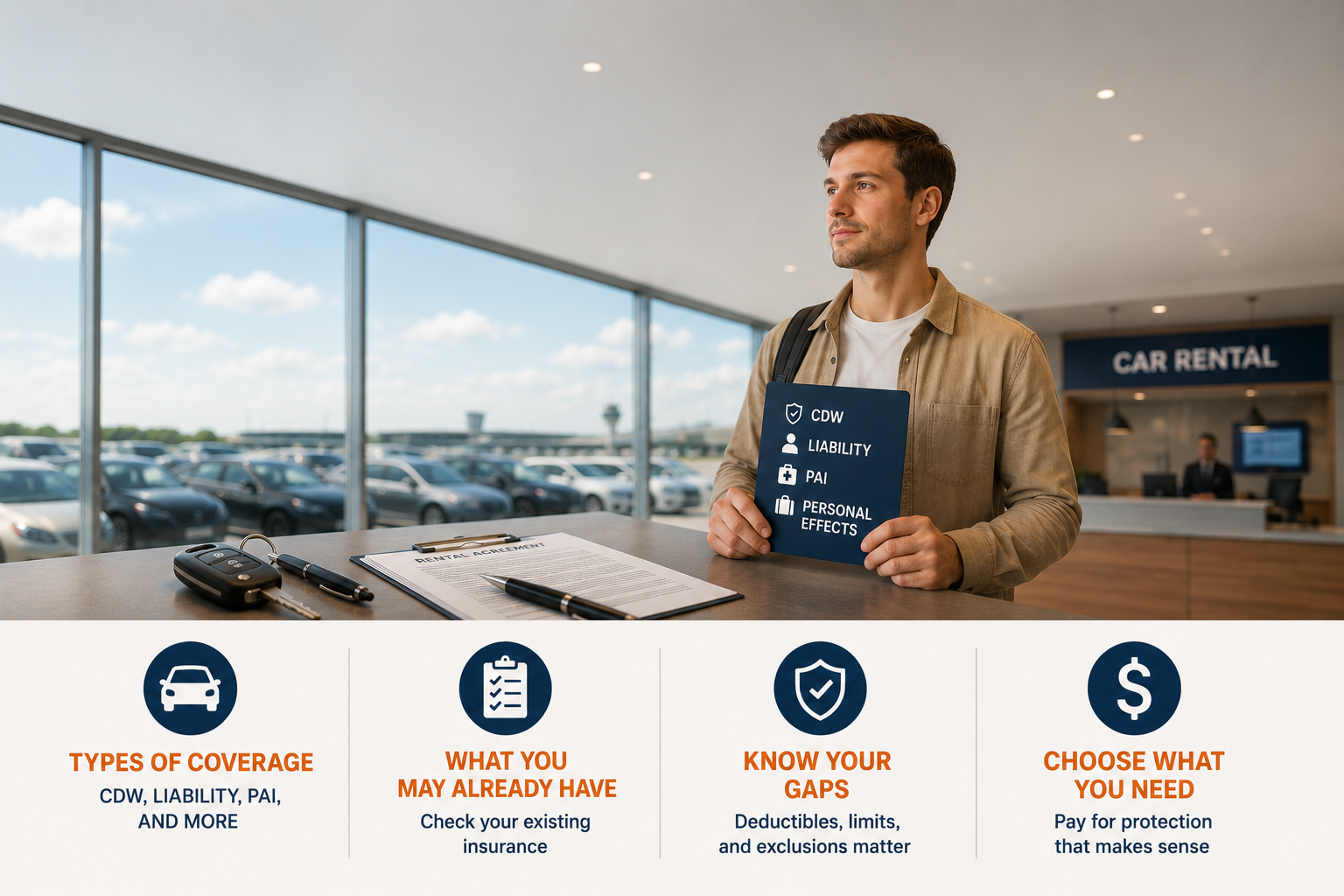
WHAT IS RENTAL CAR INSURANCE IN THE U.S.?
Main Types of Rental Car Protection
Rental protection terms vary by rental company, pickup location, state, and selected package. Before signing the agreement, check what is included in the quoted rate, which products are optional, what deductible or financial responsibility remains, and which uses or types of damage are excluded.Collision and Theft Protection: CDW and LDW
Collision Damage Waiver (CDW) or Loss Damage Waiver (LDW) may reduce or waive the renter’s contractual responsibility for covered damage to, or theft of, the rental vehicle. It is generally a waiver offered under the rental agreement rather than standard auto insurance. Its effect depends on the selected package, any deductible or retained responsibility, listed exclusions, and compliance with the agreement. Depending on the rental agreement, CDW or LDW may address covered repair costs and theft-related losses. Towing, loss-of-use charges, diminished value, administrative fees, glass, tires, wheels, the roof, and undercarriage may be included, limited, or excluded. Some products waive most covered charges, while others leave the renter responsible for a stated amount. CDW or LDW should not automatically be interpreted as «zero out-of-pocket cost.» Check whether the agreement leaves you responsible for a deductible, excluded vehicle parts, unauthorized use, loss-of-use charges, administrative fees, or damage that results from violating the rental terms. Exact exclusions vary by rental company and protection package. Common items to verify include:- Glass, mirrors, lights, tires, and wheels
- Roof, undercarriage, or interior damage
- Lost keys, lockouts, or misfueling
- Unauthorized drivers
- Driving outside the permitted territory
- Off-road or prohibited use
- Reckless driving or driving under the influence
- Damage reported outside the required claim procedure
Liability and Injury Coverage: SLI and PAI
Supplemental Liability Insurance (SLI) may increase the liability protection available for covered bodily injury or property damage claims made by other people. It does not cover damage to the rental vehicle itself. The amount of liability protection already included with a U.S. rental varies by state, rental company, and agreement. Do not assume that the minimum protection supplied with the rental matches the limits on your personal auto policy. Before purchasing SLI, check:- the bodily injury and property damage limits already available;
- whether your personal auto liability coverage extends to the rental;
- whether SLI is primary or excess over other applicable insurance;
- whether the stated limit includes or sits above the underlying protection;
- excluded drivers, prohibited uses, and territorial restrictions.
Personal Effects Coverage (PEC): Protecting Belongings in the Cabin
What is PEC? Personal Effects Coverage (PEC) may cover specified personal belongings stolen from the rental vehicle, subject to an aggregate limit, per-item limits, exclusions, and claim documentation requirements. The available limits vary by rental company and product. What PEC May Cover:- luggage, clothing, and other eligible personal property stolen from the rental vehicle;
- specified electronics, subject to per-item and aggregate limits;
- property belonging to covered passengers, if the policy includes them.
- cash, jewelry, collectibles, and other high-value property;
- items left in an unlocked vehicle or without evidence of theft;
- business equipment or property exceeding the per-item limit;
- losses not supported by a required police report or proof of ownership;
- property recoverable under another applicable policy.
- You don’t have homeowners/renters insurance or travel insurance with baggage coverage.
- You prefer a separate rental-company product after comparing its cost, deductible, limits, and exclusions with your existing property coverage.
- Report the theft to local law enforcement as soon as possible when required by law, the rental agreement, or the applicable coverage terms.
- Notify the rental company and coverage provider as soon as possible and within the deadlines stated in the rental agreement and policy.
- Provide receipts or proof of ownership for stolen items, photos of forced entry or damage, and any other documentation requested.
Rental Car Protection Comparison
Coverage Summary Table
| Product | Main risk addressed | Does not normally replace | What to verify |
|---|---|---|---|
| CDW or LDW | Contractual responsibility for covered damage to or theft of the rental vehicle | Liability for injuries or damage to other people | Remaining responsibility, excluded parts, loss of use, and administrative fees |
| SLI | Covered bodily injury and property damage claims made by third parties | Damage to the rental vehicle | Available base limit, total SLI limit, and primary or excess status |
| PAI | Defined accident benefits for covered occupants | Full health insurance or liability coverage | Covered persons, benefit limits, exclusions, and duplicate coverage |
| Personal Effects Coverage | Theft of specified personal belongings | Damage to the rental vehicle or third-party liability | Per-item limits, aggregate limit, deductible, and proof requirements |
Coverage You May Already Have
Personal Auto Insurance
A personal auto policy may extend some liability, collision, and comprehensive coverage to a rental vehicle used for personal purposes in the United States. The scope of protection depends on the policy, state rules, vehicle type, and circumstances of the rental. Before declining the rental company’s CDW or LDW, ask your insurer:- whether liability coverage extends to the rental;
- whether collision and comprehensive coverage apply;
- which deductible would apply;
- whether loss of use, diminished value, towing, storage, and administrative fees are covered;
- whether the vehicle class or value creates a limitation;
- whether every planned driver is covered;
- whether delivery, rideshare, or other business use is excluded.
Credit Card Rental Benefits
Some credit cards include a rental vehicle damage or theft benefit when an eligible rental is paid for with the card. The card network name or card tier alone does not confirm that the benefit is included. Read the current Guide to Benefits for your exact card account. Verify:- whether the benefit is primary or secondary;
- whether you must decline the rental company’s CDW or LDW;
- whether the full rental cost must be charged to the card;
- whether additional drivers are covered;
- which vehicle types are excluded;
- the maximum eligible rental period;
- whether loss of use, towing, and administrative fees are covered;
- how quickly an incident must be reported;
- which documents are required for a claim.
Third-Party Rental Car Protection
Independent rental vehicle protection may be available through a travel insurer or specialized provider. These products are not automatically equivalent to the rental company’s CDW or LDW. Some third-party policies use a reimbursement model. After a covered loss, the rental company may charge the renter first, and the renter must then submit a separate claim for reimbursement. This can require sufficient available credit or cash while the claim is reviewed. Before purchasing a third-party product, verify:- whether the policy is available in your state;
- whether it covers the full value of the rental vehicle or only a deductible;
- whether it includes theft, loss of use, towing, administrative fees, glass, tires, keys, and undercarriage damage;
- whether luxury vehicles, trucks, vans, or long-term rentals are excluded;
- whether liability coverage is included;
- whether the rental company must be paid before reimbursement;
- which police reports, photographs, receipts, and rental documents are required.
What to Do After an Accident or Theft with a Rental
If an accident, theft, vandalism, or other loss occurs, follow the rental agreement and every applicable insurance or card-benefit reporting requirement. Do not assume that all providers use the same deadline.At the scene
- Move to a safe location when possible and call emergency services if anyone is injured.
- Follow state law concerning police reports and information exchange.
- Photograph the vehicles, license plates, road conditions, damage, and relevant signs or signals.
- Collect the other driver’s name, contact information, vehicle information, and insurance details.
- Avoid speculating about fault. Provide accurate factual information.
Notify the rental company
Contact the rental company as soon as it is safe to do so. Use the emergency or claims number in the rental agreement and request written instructions. Ask whether the vehicle may be driven, where it should be returned or towed, and which incident forms are required.Notify every applicable coverage provider
If you may rely on a personal auto policy, credit card benefit, travel policy, or third-party rental protection, notify each provider within its stated deadline. One provider’s notification does not automatically satisfy another provider’s requirements.Keep copies of
- the rental agreement;
- the vehicle inspection report;
- photographs and videos;
- the police report or incident number, when applicable;
- towing and storage receipts;
- the rental company’s damage report and repair estimate;
- correspondence with the rental company and insurers;
- claim reference numbers.
Mistakes That Can Jeopardize a Claim
A claim may be delayed, limited, or denied if the renter uses an unauthorized driver, violates territorial or use restrictions, misses a reporting deadline, fails to obtain a required report, provides incomplete documentation, or continues driving an unsafe vehicle. The consequence depends on the agreement, policy, and facts of the incident.Checklist Before You Accept or Decline Rental Car Coverage
- Read the rental agreement for permitted drivers, territory, prohibited use, reporting duties, and damage charges.
- Check what liability and vehicle damage protection is already included in the quoted rate.
- Ask your auto insurer whether liability, collision, and comprehensive coverage extend to the rental.
- Confirm the deductible and whether loss of use, diminished value, administrative fees, towing, and storage are covered.
- Read the current Guide to Benefits for the exact credit card you will use.
- Confirm whether the card benefit is primary or secondary and whether declining CDW or LDW is required.
- Check excluded vehicle types and the maximum eligible rental period.
- Determine whether a third-party policy pays the rental company directly or reimburses you after you pay.
- Make sure every driver is authorized under the rental agreement.
- Inspect and photograph the vehicle before leaving the rental location.
- Save the agreement, inspection report, policy documents, benefit guide, and claim contact information.
- Confirm that the vehicle will be used only for purposes permitted by the agreement and applicable coverage.
Quick Decision Guide for U.S. Rentals
You have personal auto insurance with collision and comprehensive
Ask whether it extends to the rental, which deductible applies, and whether loss of use, diminished value, and administrative fees are covered. Compare those terms with the rental company’s CDW or LDW.You have a credit card with a rental benefit
Read the current Guide to Benefits. Confirm that the rental, vehicle, driver, duration, and payment method are eligible. Do not assume the benefit includes third-party liability.You do not carry personal auto insurance
Determine what liability protection is included in the rental and review the rental company’s vehicle damage waiver. A credit card benefit may cover eligible damage to the rental vehicle but normally should not be treated as liability insurance.You are concerned about medical expenses
Compare PAI with your health insurance, MedPay or PIP coverage, and any travel or accident policy.You are concerned about belongings in the vehicle
Compare PEC with off-premises coverage under homeowners, renters, or travel insurance.You plan to use the vehicle for delivery, rideshare, or other paid work
Stop and confirm that the rental agreement and insurance expressly permit commercial or for-hire use.Comparison Table: Counter vs. Card vs. Third-Party vs. Personal Policy
| Coverage source | What it may provide | Main limitation | Document to check |
|---|---|---|---|
| Rental company CDW or LDW | May reduce contractual responsibility for covered damage to or theft of the rental vehicle | May contain exclusions and does not normally replace third-party liability coverage | Rental agreement and waiver terms |
| Rental company SLI | May provide additional protection for covered third-party liability claims | The limit and relationship to underlying coverage vary | SLI policy or coverage summary |
| Personal auto policy | Liability, collision, and comprehensive coverage may extend to a personal-use rental | Deductibles, exclusions, state rules, and claim consequences apply | Auto policy and written insurer confirmation |
| Credit card benefit | May cover eligible damage to or theft of the rental vehicle | May be primary or secondary and normally does not replace liability coverage | Current Guide to Benefits |
| Third-party rental policy | May reimburse eligible rental vehicle damage charges | The renter may have to pay first, and exclusions vary | Insurance policy and claim terms |
| Health insurance or PAI | May address specified medical expenses or accident benefits | Does not cover damage to the rental vehicle or third-party liability by itself | Health plan documents or PAI certificate |
| Homeowners, renters, or PEC | May address theft of eligible personal belongings | Deductibles, per-item limits, aggregate limits, and exclusions apply | Property policy or PEC terms |
FAQ
CAR
INSURANCE
FOR
17-YEAR-OLDS:
COSTS, LEGAL OPTIONS,
AND THE CHEAPEST
WAY
TO GET COVERED
- Can a 17-year-old buy car insurance alone? In many cases, not easily. A 17-year-old often needs a parent, guardian, or another adult involved because contract rules for minors and insurer underwriting requirements can limit independent purchase. The exact setup depends on state law and the insurance company.
- Cheapest setup? In most cases, staying on a parent’s existing policy is still the cheapest starting point. After that, the biggest savings usually come from telematics, good-student eligibility, and choosing a lower-risk vehicle.
- Typical cost at 17? Insurance at 17 is usually expensive, especially for full coverage. National averages can help set expectations, but the real quote will depend heavily on the household policy, vehicle, address, and insurer.
- Must you list a permit holder? Usually yes. Insurers typically require teens with learner’s permits to be listed on household policies. — Zacks, 2024.
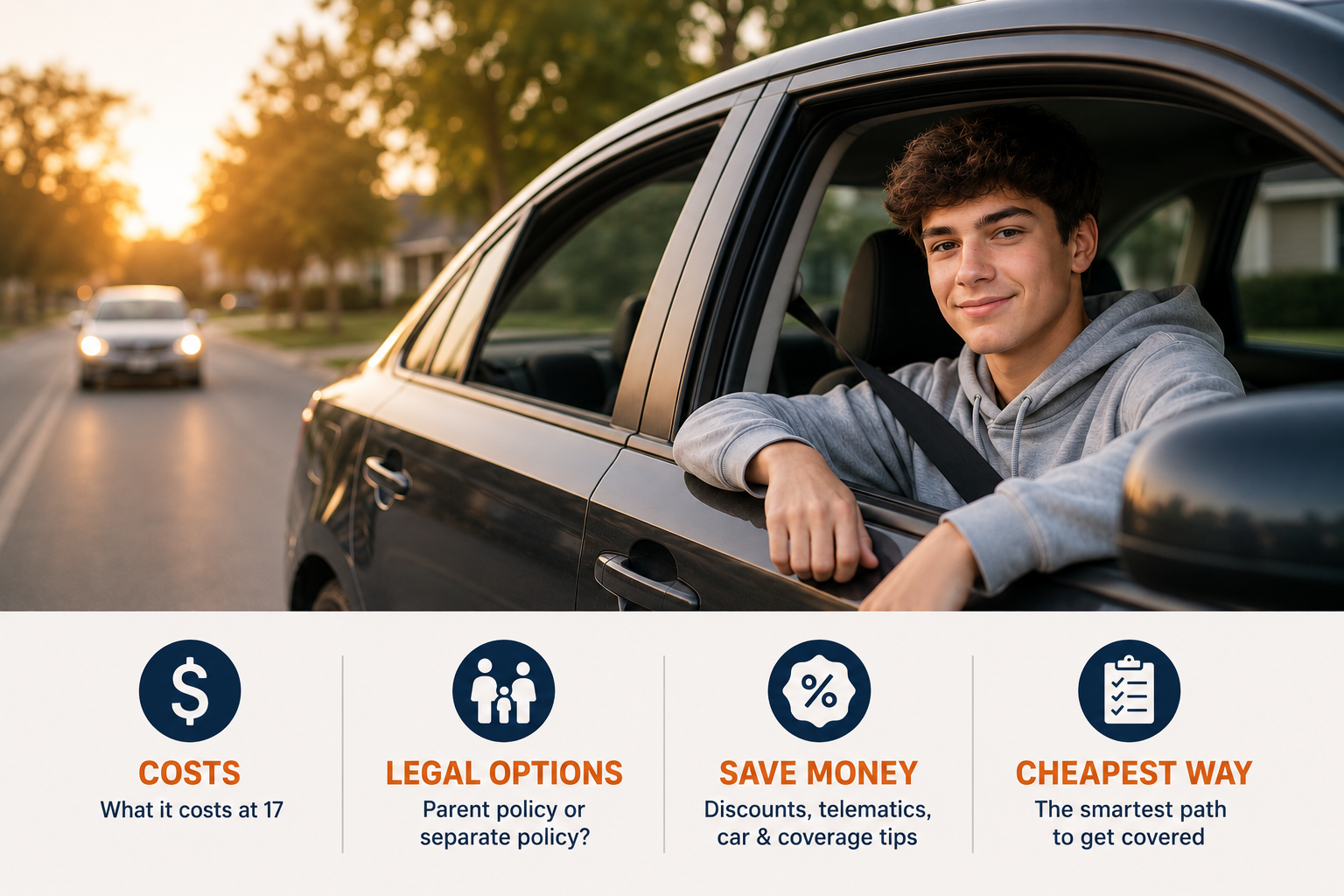
WHAT IT COSTS AT 17: AVERAGES AND WHEN RATES DROP
Typical premiums and when they decline
Insurance is usually expensive at 17 because the driver has limited experience and a short rating history. Rates often improve over time, but the first meaningful savings usually come from staying claim-free, using the right vehicle, and keeping the policy structure clean — not from age alone.What drives the price most
The price usually moves the most based on four things: who the teen is insured with, what car is being insured, where the car is kept, and how much liability protection is chosen. For most families, the biggest mistake is focusing only on the teen’s age while ignoring the vehicle, the garaging address, or the difference between a parent policy and a separate policy.Add to Parent vs Separate Policy: Choose the Right Setup
Which is cheaper and exceptions
For most 17-year-olds, the lowest-cost setup is still being added to a parent or guardian’s existing policy instead of buying separate coverage. That is usually where the household can keep multi-car, bundling, and tenure-based pricing advantages. A separate policy becomes more realistic only when ownership, garaging, household driving history, or underwriting rules make the family policy a poor fit. A separate policy may make more sense when the parent has a poor driving record, when the car is titled only to the teen, or when the vehicle is kept at a different address than the household policy shows. Those situations can change underwriting enough that the «cheap parent policy» assumption stops being true.Requirements and pitfalls
Before buying or titling the car, check whether the insurer will allow that vehicle on the household policy. Some insurers are comfortable when the car is titled to the parent or jointly. Others may require a separate policy if the vehicle is titled only to the teen. If you ignore that step, you can end up with the wrong policy structure from day one. The address where the car is actually kept matters more than many families expect. If the teen lives part-time somewhere else or the vehicle is regularly parked away from the household address, that can change underwriting and sometimes force a different policy setup. Check that before you buy the car, not after.| Scenario | Usually cheaper setup | Why | What to verify |
|---|---|---|---|
| Standard household | Add to parent’s policy | Household pricing advantages often make this the lower-cost option. | Confirm the teen lives at the same address and the vehicle can stay on the household policy. |
| Parent with poor driving history | Separate policy may be worth comparing | The parent’s record can make the household policy much more expensive. | Compare both setups and check whether the parent’s history is driving the quote up. |
| Vehicle titled only to the teen | Separate policy is often more realistic | Some insurers will not keep that vehicle on the parent’s policy. | Check ownership rules before buying or titling the car. |
| Car kept at a different address | Separate policy may be required | The actual garaging location can change underwriting and eligibility. | Verify where the vehicle is kept most of the time and how the insurer wants it listed. |
| Low-risk vehicle and strong household profile | Add to parent’s policy | A safer vehicle and a clean household record often support better pricing. | Make sure the vehicle, drivers, and garaging details all match the application. |
| Teen needs separate underwriting review | Separate policy | Ownership, address, or driver setup may not fit the household policy. | Confirm whether the insurer accepts the teen, the vehicle, and the address under one policy. |
Pay Less Today: Discounts, Telematics, Car and Coverage Tweaks
Discounts and programs that move the needle
If the goal is to lower the price quickly, focus on the discounts that usually matter most first: telematics, good-student eligibility, and staying on an existing household policy when possible. Smaller items like paperless billing or autopay may help a little, but they do not usually change the quote as much as the policy structure, vehicle choice, or driving-score programs. Do not assume discounts stack neatly in a predictable order. Insurers calculate them differently, and some discounts may not combine the way consumers expect. The practical move is to request quotes both with and without telematics, confirm good-student eligibility, and compare the final premium rather than relying on generic savings examples. Some insurers offer student-related discounts when the teen studies away from home and does not keep regular access to the vehicle. Eligibility rules vary, so treat this as a possible extra — not as a core savings strategy. Required documentation by discount:- Good student: GPA transcript or report card (B average or better).
- Driver’s education: certificate of completion.
- Telematics: app download/device installation; consistent data transmission.
- Distant student: school enrollment verification, proof of garaging at family residence.
Car, coverage, deductibles—what to change safely
Choose a vehicle that is cheaper to repair, less likely to be stolen, and less likely to be rated as a performance risk. For teen drivers, the wrong car choice can push the premium up fast, even before coverage selections are adjusted. The cheapest quote is not always the safer choice. Cutting liability down to the state minimum may save money upfront, but it can leave the household badly exposed after a serious at-fault crash. A better approach is to compare at least two versions of the quote — one near the minimum and one with meaningfully stronger liability limits — and see how much real premium difference there is. Common mistake: Cutting liability limits to state minimums to save premium, exposing the household to significant personal liability in a serious at-fault accident.How to Compare Coverage at 17 Without Relying on State Minimums
Minimums vs stronger protection
State minimum liability limits are often insufficient for real-world injury and property damage costs. Teens face high-severity risk due to inexperience. A single at-fault accident involving serious injuries can generate claims far exceeding state minimums. For most families, the better question is not «What is the one right coverage setup?» but «How much extra protection do we get for the added premium?» That comparison matters more than copying a generic recommendation, especially when state rules, vehicle value, household finances, and insurer underwriting can differ so much.How to compare quote versions in practice
State minimum coverage may be enough to drive legally, but it may not be enough to absorb the financial damage from a serious crash. That matters even more for teen drivers because one early at-fault accident can create a large liability problem for the household. Instead of copying a generic coverage matrix, compare quotes in versions. Look at how the premium changes when liability protection is increased, when deductibles are adjusted, and when coverages such as UM/UIM, collision, or comprehensive are added or removed. That gives a more realistic decision than relying on one universal set of limits.NY Quick Facts: Requirements and Local Context
NY quick facts
If the policy is being written in New York, do not rely on generic national advice alone. New York has its own minimum liability requirements, no-fault rules, and insurer procedures. For teen drivers, especially minors, permit holders, or households with unusual ownership or garaging arrangements, the safest move is to verify current rules directly with NY DFS, NY DMV, and the insurer before binding coverage.Step-by-Step: How to Get Insured at 17
If joining a parent/guardian policy
If the teen is joining a household policy, start by confirming three basics: who owns the car, where it is actually kept, and whether the permit holder or licensed teen must be listed now. Those details affect both price and underwriting, and getting them wrong early can create bigger problems later. Once the vehicle and policy structure make sense, compare the quote in more than one coverage version and confirm the effective date before the teen drives alone. After that, finalize billing, make sure the teen is correctly listed, and keep proof of insurance ready for the vehicle.Steps
- Confirm the policy can legally and practically fit the teen, the vehicle, and the garaging address.
- Compare quotes in more than one coverage version, not just by headline price.
- Bind coverage only after discounts, listed drivers, and effective date are confirmed in writing.
If standalone with an adult co-signer
If a separate policy is the only realistic option, check three things before moving forward: whether the insurer accepts that setup for a minor, whether the vehicle title and garaging address fit the application, and whether the final premium still makes sense compared with staying on a household policy. Separate coverage can solve a policy-fit problem, but it often stops being the lower-cost option.Steps
- Verify co-signer requirements and state rules regarding minor policyholders. Confirm that the co-signer meets the insurer’s eligibility criteria.
- Choose an insurable, low-risk vehicle. Set higher deductibles if needed to manage premium. Enroll in telematics if the insurer offers usage-based pricing.
- Bind the policy. Schedule telematics device installation or mobile app activation. Plan to re-shop at 6 to 12 months of clean driving to compare rates and potentially transition to a lower-cost option.
Documents and Common Errors Checklist
Most teen-policy problems do not start with complicated legal issues. They start with bad details: the wrong garaging address, a missing household driver, a title mismatch, or discount paperwork that does not match the application. That is why the review step matters before the policy is bound. Before you bind:- Match names on license, vehicle title, and policy application.
- Confirm VIN accuracy.
- Verify garaging address matches where vehicle is kept most of the time.
- List all household drivers (including permit holders).
- Submit required documents for discounts (GPA transcript, driver’s ed certificate).
- Review coverage selections and ensure lienholders are satisfied (if financed).
- Mismatch between garaging address and actual vehicle location.
- Failure to disclose all household drivers.
- Incomplete or expired driver’s education certificates.
- VIN errors.
- Insufficient proof of good student status.
When It Makes Sense to Compare Quotes Again
Re-shop the policy after a clean renewal period, after the teen moves from permit to licensed driving, after a vehicle change, or when a meaningful discount becomes available that was not on the original policy. In practice, the first smart re-check is often around the first renewal rather than on an arbitrary age milestone.Common mistakes that make teen insurance harder or more expensive
Families often overfocus on the teen’s age and underfocus on the details that actually change underwriting. The most common mistakes are buying the car before checking policy fit, using the wrong garaging address, failing to disclose all household drivers, and chasing the lowest quote without comparing liability protection.FAQ
TLC
UPDATE
5% DRIVER PAY RAISE &
APP LOCKOUT PROTECTIONS

WHAT DID TLC APPROVE?
The new rules include:
- 5% driver pay increase to improve earnings and stability for for-hire drivers.
- Protections against sudden app lockouts to reduce unexpected work interruptions.
- Updated “utilization rate” calculation to make the pay formula fairer and more transparent.
WHY THIS MATTERS FOR TLC DRIVERS
Predictability is as important as pay. When platform access or demand fluctuates, sudden lockouts can erase a day’s income. These TLC changes are meant to create more stability, clearer standards, and steadier earning potential.
Whether you drive full-time or part-time (or switch between apps), the rules can affect how you plan your schedule, forecast weekly income, and protect yourself financially when something unexpected happens.
WHAT YOU SHOULD DO NEXT
- Stay compliant with TLC requirements. Keep licensing, registrations, and required documents up to date.
- Keep your insurance correct and active. If your activity changes (apps, mileage, vehicle, business use), review coverage.
- Re-check your setup if your work pattern changes. Rule updates or schedule shifts are a good time to revisit limits and filings.
HOW A&Y ROYAL INSURANCE BROKERAGE CAN HELP
TLC updates touch more than pay—changes in when and how you work can alter your risk and paperwork. A&Y Royal Insurance Brokerage helps TLC drivers stay compliant and properly covered—on and off the app.
Need help now? Get a quick coverage review to confirm your policy fits current TLC driving needs.
A
COMPARISON
BETWEEN CAR
RENTAL COMPANIES
But, it becomes an important source when you don’t have the money to buy a vehicle or don’t want to lease one.
Also, in comparison to all the process of buying, car rental is highly versatile and can help you gain many benefits. In accordance to it, there’s no trouble while down payment or credit also.

SHOULD YOU RENT A CAR
FOR UBER ?
TIf you wonder as to why renting is so beneficial, then you should definitely read the following:
- It provides you a chance to determine whether this kind of work is apt for you or not. Thereby saving you from the horror as well as the loss of being obliged to a long term loan or lease.
- It’s also a viable option in situations where your rideshare car breaks down and you temporarily become unemployed till the car is up in the repair shop.
- It gives temporary employment to the drivers such as students and those who are unable to drive due to any reasons.
- It helps you to relieve stress which can be caused due to expenses such as depreciation, maintenance and insurance because such expenses are fixed and expected.
- Finally, renting gives you the chance to test the car in the real world to make sure your purchased car is the right choice.
WHY CAR RENTAL IS A BIG DEAL?
Purchasing a vehicle for rideshare is anything but cheap, stress-free and easy. To top it all of, Uber and Lyft have both decided to reduce the fare costs so that the demand for rides could be increased. This however, leads drivers with less earnings because their pay is based upon the total of the fares. Other things that add up to the stress for Uber and Lyft drivers is the operating cost of the vehicles which fluctuate due to:
- Type of the vehicle,
- State of the car: new or old,
- Gas mileage,
- Financing terms.
In comparison to this, in car rental program:
- You only have to pay weekly fee which includes insurance and maintenance costs.
- You can drive as much miles as you can because there’s no depreciation expense cost.
- You’ve the liberty to return the vehicle in case you don’t want to drive anymore. Also, there’ll be no objection if you want to rent a car again to drive for two-three weeks.
FAIR APP
If in case you’re unaware of this news then, we must tell you that recently, Fair obtained the Uber’s Xchange Leasing portfolio. Also, it has entered into a partnership agreement with Uber wherein, it can now offer rideshare cars to Uber drivers. However, this opportunity is right now limited to only three states:
- California
- Philadelphia
- Seattle.
If you’re living in any of these three states, then we highly recommend you to begin your application with Fair. Furthermore, you can download Fair app from the Google Play Store or iOS App Store. From there, you can sign in through your Uber account to search for a suitable car.
But, one thing that Uber drivers have to keep in mind is that Fair also provides car to non-rideshare drivers. Therefore, it’s imperative to always sign in using the Uber option of the app before searching for a vehicle.
HYRECAR
With features such as no contracts, no sign-up fees
What is Hyrecar, if one may ponder? Unlike Fair, Hyrecar is a car rental market. It’s specifically built up for companies such as Uber and Lyft and on-demand delivery apps such as Ubereats, Postmates and DoorDASH. If you want to know more about these on-demand delivery apps then.
Advantages:
- You have the freedom to select your desired vehicle depending upon location, model and price.
- You get the chance to ascertain whether your desired car is fit for Uber and Lyft before you stress yourself with car purchasing.
- They offer quick and quality service to the drivers. That is, you can obtain your rented car in less than 24 hours.
LYFT EXPRESS DRIVE
Lyft rental car program:
Like Uber, Lyft is also focusing on promoting car rental among Lyft drivers.
- Hertz, one of the most important and major partner of Lyft have prompted an express drive program for the Lyft drivers. According to this program, Lyft express provides you with the offer of weekly car rental rates for the rented vehicles.
- MONEY CHARGED BY LYFT TO RENT A CAR: If you’ve deposited $250 in the Lyft account, then your rate could go down to $209 per week. However, there’re few limitations to this such as:
- You can only use your rented car for Lyft riders.
- Your minimum number of rides should amount to 85.
In case you fail to exercise these two things then, you may not be able to utilize this exclusive Lyft rental discounted rate.
IMPORTANT NOTE: The car rental fees of Lyft is charged from your Lyft earnings.
- They offer unlimited mileage.
- Places where you can find Lyft express service:
- Washington D.C.
- Tampa Bay
- San Jose
- Portland
- San Diego
- Sacramento
- San Francisco
- Phoenix
- Philadelphia
- Orlando
- Orange County
- New Orleans
- Nashville
- Miami
- LA
- Las Vegas
- Houston
- Denver
- Dallas/Fort Worth
- Chicago
- Boston
- Baltimore
- Austin
- Atlanta
- The driver should be at least 25 years old if he/she wants to rent a car through Lyft express.
- Every 28 days, your rented car will have a maintenance inspection as stated by Lyft. During this time period, you’ll be temporarily unemployed as you would have to return the car for inspection. In addition to it,
availability of another car while your rented car is being inspected is close to none. - Repairs are included through the mechanics. They’re in a partnership agreement with Lyft.
Lyft rates:
Lyft rates consists of the following taxes and fees:
- Always make sure that the car tank is full when you return the car because if the car tank contains fuel with the quantity less than quarter/is quarterly filled, then you’ve to pay $18.75.
- Desist smoking in the car and also, don’t allow any rider to do so. Any damage caused due to smoking, will result in a fine of $300.
- The dropping of the car results in a fee of $33.
- Don’t allow entry of pets in the car. Any damages caused due to pets will result in a fine of $250.
Lyft insurance:
- EXPRESS DRIVE RENTER’S INSURANCE: This insurance highly depends upon the driving periods you’re in, when you unfortunately meet an accident. These riving periods are:
- PERSONAL DRIVING: It indicates of the time when your Lyft app isn’t open while you’re driving.
- RIDE IN PROGRESS: The time period when you’ve accepted a ride request and have reached the final destination.
- WAITING FOR REQUESTS: This includes the time when you’ve successfully logged in and are now waiting for a ride request.
Vehicles provided to you through Lyft Express will not be according to your choice. These vehicles mostly include midsize sedans such as Chevy Malibu or Nissan Altima.
- COVERAGE PROVIDED: In case of accidents, the insurance provides coverage:
- LIABILITY: The insurance offers coverage $1,000,000 per accident for liability.
- PHYSICAL DAMAGE: You’re given $2,500 deductible on any type of physical damage.
Furthermore, in case of an accident where there’s an involvement with an uninsured or under-insured motorist, Lyft is going to provide you with coverage. However, that coverage will be to the limit of local regulations and/or state laws. Therefore, it’s always advised to drive safely and within limits to avoid such circumstances.
Takeaways:
- To be able to drive on the road, you’ve to pay $459 as a weekly rental. This amount includes the deposit as well.
- The fee of the rental car
depends on the number of rides you’ve done in a given week. - Driving for Uber is prohibited. If found, the driver’s profits would cut down.
- Lyft drivers aren’t qualified for Express Pay or driving bonuses.
- The rental period should be at least 7 days.
- As Lyft Express Drive is only available at specific places, you’re required to call for an appointment before you want to apply. However, receiving your rented car can take several weeks.
LYFT FLEX DRIVE
Difference between Lyft Flex Drive and Lyft Express Drive:
There is a slight difference between Lyft Flex Drive and Lyft Express Drive:
- Lyft Flex Drive is available in places such as:
- San Francisco
- Philadelphia
- LA
- Houston
- Atlanta
- Drivers will be able to rent cars only at selected CarMax locations.
Takeaways:
It is same as the Lyft Express Drive.
UBER-ENTERPRISE RIDESHARE RENTAL PROGRAM
Uber entered into a partnership agreement with Enterprise last December and have successfully expanded its routes to places like:
- Boston
- Chicago
- Denver
- LA
- New Jersey
- San Diego
- SF
About the program:
- The rental fees include $215 per week which includes both taxes and fees. Also, you’ve to pay $40 fee as a startup for the first week when you rent a car.
- The refundable deposit amount equals to $250.
- It offers you unlimited mileage.
- The maintenance is taken cared by the Enterprise.
- The drivers have to maintain a rental period of 7 days minimum and a maximum of 28 days.
Types of vehicles:
It’s important to be remembered that Enterprise carries a higher base fee than Hertz. But, it offers more availability of cars. The types of vehicles available by Enterprise are:
- Chevy Cruze
- Dodge Dart
- Ford Focus
- Honda Civic
- Hyundai Elantra
- Nissan Sentra
- Toyota Corolla.
UBER-HERTZ RENTAL PARTNERSHIP
Since many people are opting for rideshare companies these days, Hertz has entered into a partnership agreement with both the TNCs i.e. Uber and Lyft. As mentioned above, the rental fee of Hertz is less according to Enterprise at $180 per week.
About Hertz:
- There’s no requirement of credit.
- The rental fee of Hertz
is $180 per week including both taxes and fees. However, there’s no start-up fee. - The refundable deposit amount equals to $250.
- It offers you unlimited mileage.
- The maintenance is taken cared for by Hertz.
- The drivers have to maintain a rental period of 7 days minimum and a maximum of 28 days.
- Hertz Loss Damage Waiver provide insurance to the drivers only in periods 1 and 2. However, Uber provides insurance only in period 3.
Vehicle types:
Vehicles similar to Toyota Corolla.
MAVEN GIG:
Maven Gig is a General Motor’s leisure car rental business. It provides rented cars to TNCs companies such as Uber and Lyft and on-demand delivery apps such as UberEATS, Postmates,DoorDASH and etc.
There is another service — GM’s Maven car sharing which is owned by General Motors. It’s a car rental program. However, it’s different from Maven Gig.
Pricing:
It depends upon the type of car you want to rent. Such as:
- Compact/Sedan requires $189 per week.
- Crossover SUV requires $199 per week.
- Electric cars require $229 per week.
Fees:
- Deposit is required of $400.
- In case of delays, there’s a fee of $50 per day with a processing fee of $20.
- If you travel interstate, the fees adds up to $500.
- Damages due to smoking results in $300 fees.
- If the car fails to be serviced on schedule then, $150 penalty will be charged.
- There’ll be $150 charged if there’re any wear and tear in the car.
Other data:
- There’s unlimited mileage.
- Drivers should be of at least 21 years in age.
- Every 28 days, maintenance is required.
- Vehicles included in Maven Gig are:
- Compact cars such as Chevy Cruze.
- Sedans such as Chevy Malibu.
- Crossover SUVs such as Chevy Trax.
- Electric cars such as Chevy Bolt EV.
- Drivers can rent cars only at dealerships or dedicated lots that are partnered with Maven. Places where Maven Gig include:
- Austin
- Boston
- Detroit
- Los Angeles
- Phoenix
- San Diego
- San Francisco
- Washington D.C.
- The rental commitment should be minimum of 7 days.
Insurance:
According to Maven Gig contract, when you’re driving a Maven car and find yourself in an accident then, you’ll be insured up to the minimum state coverage given. In case of an accident where the rented car is involved, $750 will be charged to the drivers.
Furthermore, rental fee
Takeaways:
- The rental fees paid by the drivers is between $589-$629 which includes the deposit as well. However, the fees depends upon the type of the car.
- The front deposit is $400 which is a little costly.
- You’ll also find many penalty fees added up.
- You can choose from a variety of vehicles which comprises of hybrids. However, there’re limited pick-up locations.
GETAROUND
The Getaround car rental service is a peer to peer vehicle sharing service. It provides car rental solutions to rideshare drivers.
Pricing:
- The price depends upon the year, make and model of your rented car. Usually, it’s $5-$8 per hour or $41 on average per day.
- Late fees starts from $50 per hour and can go to a maximum of $500. Also, there’re other fees that can add into it.
- If you’re a first time renter then, you’ve to pay a deposit fee of $150. Also, if the drivers who are the members of Getaround, have one or more violations on their record then, they have to pay $250. It’s called Good Faith Deposit which means that it’s refundable.
Mileage limits:
There’s a mileage limit of 20 miles per hour i.e. 200 miles in a 24 hour period. If you continue even after that, $0.50 per mile is charged extra.
Locations:
If you want to drive for Uber and Lyft and use the rented car of Getaround then, you can drive only in San Francisco/Bay area. However, if you want to rent a car, you can use the app. Through that, you can unlock the vehicle that you’ve selected at a pre-selected location.
Other facts:
- AGE FACTOR: If you’re an international driver or you drive for specialty cars, the age should be 25 years.
- INSURANCE: The renter is held responsible for any incident and have to pay $1000 for damages.
- MAINTENANCE: Every 28 day there’s an inspection. The repairs are included by a partnered mechanic.
- TYPES OF VEHICLES: Vehicles include Compact cars such as Honda Fit, Sedans such as Toyota Camry and Luxury cars such as BMW and Audi.
Takeaways:
- The rental fee
is between $437-$537 which includes the deposit as well. - It’s used for short term rentals mostly.
- The rates are highly expensive due to the per hour rental fees.
- The late fee is very costly.
We provide you insurance as well as information based on any type of rideshare service you want to apply. For more information, click here.
UBER
CAR
REQUIREMENTS

2019 UBER CAR REQUIREMENTS
The Uber car requirements depends on which service you’re looking to drive for in New York City (NYC).
Requirements:
- BACKGROUND AND DRIVING RECORD CHECK: Driver must pass a background check and driving record check.
- CAPACITY: The car should have the capacity to seat 4 passengers excluding the driver. Also, there should be seat-belts in proper condition for the passengers.
- CAR MODEL: The vehicle must be 10 years old or newer with a model year of 2007. However, the model year varies from city to city.
- CAR TYPE: Drivers should opt for vehicles such as a four-door car, truck or a minivan. The manual standard transmission is also considered fine.
- FULL NAME: The driver should make sure that his full name is mentioned in the insurance documents of the vehicle.
- MECHANICAL VEHICLE INSPECTION: Driver should choose a vehicle that have passed the mechanical vehicle inspection.
- VEHICLE REGISTRATION: There’s no compulsion for driver to have his name on vehicle registration.
Uber cars:
Passengers have the liberty to choose from different services that are offered to them by Uber. The passengers can thus, select what type of vehicle and caliber of service they want. However, the availability of all types of services in every city is very low. Likewise, Uber drivers also have the right to pick their preference from the list of types of Uber vehicles.
Types of Uber cars:
- UberBLACK is generally selected by those passengers who want a luxury sedan experience. They’ve a black exterior and interior and is driven by professional drivers. This category includes mid-size/full-size cars.
- UberLUX includes only high end luxury vehicles and drivers.
- UberPOOL gives a basic UberX experience to its passengers but at more affordable rates. However, the passengers may have to carpooling i.e. share their vehicle of transport with other riders.
- UberSELECT comprises of introductory luxury vehicles with an interior that is made of leather.
- UberSUV incorporates luxury SUVs. It’s the best and highest version of UberBLACK that embodies vehicles which have a seating capacity up to 6 passengers.
- UberT/UberTAXI signifies Uber’s taxi service. It’s very common in New York City.
- UberX indicates the basic Uber service. The types of vehicles that can drive under UberX service include four-door car, mini-van or a truck. However, they can only qualify for UberX when they meet requirements such as the minimum age and safety provisions.
- UberXL entitles for larger vehicles such as minivans and SUVs that can harbor more passengers.
As the Uber vehicles are of different categories, the Uber car requirements for each type of car will accordingly be different. In order to be selected by the company before you applying to drive, you’ve to consider the following:
- Determining the type of vehicle you would like to drive for and
- Accomplish basic Uber car requirements.
This step is taken by the company to ensure the safety of its passengers.
Restrictions:
Furthermore, Uber has also accorded some vehicle restrictions in place so as to provide a quality experience to its passengers. These are:
- Prohibition of the use of Crown Victoria.
- Salvaged vehicles aren’t accepted.
- Taxis and other marked vehicles aren’t favored. However, there’s an exception of UberTAXI.
- You cannot drive for Uber with a full-size van. These include: Ford Transit, Ford E-Series and GMC Savana.
UBERBLACK REQUIREMENTS
UberBLACK vehicle requirements are as follows:
- DOCUMENTS: The car should have in-state car insurance, registration and plates.
- FEATURES: The vehicle must be in a good condition as well as have a black exterior and interior. Also, it should have four doors and a seating capacity of four riders or more.
- INSPECTION: The chosen vehicle must pass an Uber inspection.
- MODEL: Though the year of the model of the car varies by city, but many cities require 2014 and newer.
- TYPE OF VEHICLE: It must be a full-size SUV, crossover SUV or sedan.
UberBLACK includes the Uber’s luxury vehicle service. Drivers under this category should have commercial livery insurance. Also, it’s very important for the car should be commercially registered. This service is highly expensive to the passengers and therefore, it has the liberty to pay off really well as an Uber driver if you meet the requirements.
Examples:
UberBLACK vehicles are an escalation from UberSELECT. You’ll understand this from the examples given of both. Additionally, the minimum model year for the vehicles of UberBLACK jump from 2009 to 2014. Examples of UberBLACK vehicles include:
- Audi A6, A7, A8
- BMW 5 Series
- BMW 7 Series
- GMC Yukon XL
- Lexus LX
- Mercedes-Benz E-Class
- Mercedes-Benz S-Class
- Porsche Panamera
- Tesla Model S
UBERLUX REQUIREMENTS
Here’re the requirements you’ll need to meet for UberLUX:
- CHARACTERISTICS: The vehicle must be in a good condition as well as have a black exterior and interior.
- IMPORTANT DOCUMENTS: The car should have in-state car insurance, registration and plates.
- INSPECTION: The chosen vehicle must pass an Uber inspection.
- MODEL OF THE CAR: Though the year of the model of the car varies by city, but many cities require 2013 and newer.
- TYPE OF AUTO-MOBILE: It must be a full-size SUV, crossover SUV or sedan.
If you’ve the ability to afford an expensive car then, UberLUX service is the right choice for you. To encourage your willingness to a more definite level, UberLUX drivers can earn almost six figures with these types of vehicles because passengers are always willing to pay more if they get picked up in an exotic vehicle by professional drivers.
It’s the most luxurious and expensive service that is currently offered to passengers. UberLUX is a cherry on the top when it comes to rideshare vehicles.
Examples:
Examples of UberLUX vehicles include:
- Audi A8
- BMW 7 Series
- Infiniti XF
- Jaguar XJ
- Lexus GX
- Mercedes-Benz S-Class
- Porsche Panamera
- Range Rover
- Tesla Model S
UBERSELECT REQUIREMENTS
The UberSELECT vehicle requirements are as follows:
- DOCUMENTS: The car should have in-state car insurance, registration and plates.
- FEATURE: It should have four doors and a seating capacity of four riders.
- UBER INSPECTION: The chosen vehicle must pass an Uber inspection.
- MODEL: Though the year of the model of the car varies by city, but many cities require 2009 or newer.
- TYPE: It should be luxurious and have at least a leather interior. They’re typically a sedan.
Examples:
Examples of UberSELECT vehicles are:
- Acura RDX
- Acura MDX
- BMW X3 and X5
- Buick Enclave
- Cadillac CTS
- Chrysler 300
- Land Rover Discovery
- Lexus GS
- Lexus LX
UBERSUV REQUIREMENTS
These are the UberSUV vehicle requirements:
- DOCUMENTS: The car should have in-state car insurance, registration, and plates.
- FEATURES: The vehicle must be in a good condition as well as have a black exterior and interior. Also, it should be a full-size SUV with four doors and a seating capacity of six riders.
- INSPECTION: The chosen vehicle must pass an Uber inspection.
- MODEL: Though the year of the model of the car varies by city, but many cities require 2014 and newer.
UberSUV services combine both luxury and size. Similar to UberBLACK, UberSUV offers a luxurious car-ride. Here, the drivers can earn more money as the fares are highest, due to being per mile and per minute. Drivers usually find themselves riding for Limo companies under this category. However, the drivers in order to drive for this service, must be commercially registered, have an airport permit as well as maintain a commercial insurance policy.
Examples:
Examples of UberSUV vehicles include:
- Audi Q7
- Cadillac Escalade ESV
- Chevrolet Tahoe
- Ford Expedition Platinum
- GMC Denali
- Lexus LX and GX
- Lincoln Navigator
- Mercedes-Benz GL-Class
- Nissan Armada
UBERX CAR REQUIREMENTS
The UberX vehicle requirements are as follows:
- DOCUMENTS REQUIRED: The car should have in-state car insurance, registration and plates.
- FEATURES: It should have four doors and a seating capacity of six riders. It’s basic and very low priced but highly reliable.
- INSPECTION: The chosen vehicle must pass an Uber inspection.
- MODEL: Though the year of the model of the car varies by city, but some cities require 2004 or newer while some require 2009 or newer.
- TYPE: These type of vehicles are regular sedans or possibly pickup trucks.
You can get easily approved for UberX since the types of vehicles are very common. Also, It provides you with extra income. The majority of ride requests are for UberX rides.
Examples:
Example of UberX vehicles include:
- Chevrolet Impala
- Chevrolet Malibu
- Chrysler 200
- Ford Focus
- Honda Accord
- Honda Civic
- Nissan Sentra
- Toyota Camry
- Toyota Corolla
- Toyota Prius
UBERXL CAR REQUIREMENTS
The UberXL vehicle requirements are as follows:
- DOCUMENTS: The car should have in-state car insurance, registration and plates.
- FEATURES: It should have four doors and a seating capacity of six riders. They consume less fuel/gas.
- INSPECTION: The chosen vehicle must pass an Uber inspection.
- MODEL: Though the year of the model of the car varies by city, but some cities require 2004 or newer while some require 2009 or newer.
- TYPE: They’re usually minivans and SUVs.
UberXL drivers earn more money than UberX drivers.
It is very important to note that even though you give services for UberXL, you’ll still get requests from UberX passengers. Furthermore, driving for UberXL gives you the privilege to drive for both UberX and UberXL.
Full-time UberXL drivers can benefit themselves all the more by working the early morning hours around hotels. Usually, you find yourself getting a lot of requests for airport rides.
Examples:
- You can work from 10:00 p.m.-3:00 a.m. drunk shift. Before 4:30 a.m. when tourist airport runs begin, eat your breakfast and take a short break. However, you can sleep during the day when part-time drivers are doing their day job.
- Let’s say you drove 500 miles at UberX rate of $1.10 per mile in a given week. This equals to $550 in earnings. However, in case of UberXL, the earnings will rise to $800.
Examples of UberXL vehicles include:
- Chevrolet Suburban
- Chrysler Town and Country
- Dodge Caravan
- Ford Expedition
- Ford Explorer
- Honda Pilot
- Honda Odyssey
- Hyundai Santa Fe
- Jeep Cherokee
- Nissan Pathfinder
- Toyota Sienna
DO YOU MEET THE UBER CAR REQUIREMENTS?
Though the Uber car requirements seem a little intimidating and scary, but they’re very easy if done with full attention. The requirements are:
- Being a good driver and have a clean record.
- Own a decent car that passengers would enjoy to ride in and appropriate to the driver type you want to offer.
- Passenger safety.
- Structuralize your driver and car paperwork.
Ridesharing with Uber can be very profitable and helpful in future. But it’s very important to keep all the pros n cons in mind before making a decision. And therefore here, we play a very significant role by helping you to establish a proper and definite career choice along with the proper knowledge and guidance.
BEFORE
YOU APPLY FOR
UBER VEHICLE INSPECTION:
READ THIS

UBER VEHICLE INSPECTION
The word inspection is itself terrifying, as you may have heard since your school days. However, when it comes to Uber vehicle inspection, the adjectives you can associate with it are simple and uncomplicated. But as it’s a standard practice in the industry, it carries a lot of importance.
As discussed above, Uber vehicle inspection is done to ensure that your qualified vehicle carries the level of safety which the company demands. Like Uber, Lyft drivers are also required to pass the the Lyft vehicle inspection process before they start with their professional job as a driver.
Every Uber driver is given the duty of performing and thereby, completing a full inspection of their vehicle at least once a year. This inspection can take place either at an «activation center» or a pre-approved repair shop.
Applying online will give you the benefit of completing your mechanical inspection and a full background check. But, if you apply in person, you’ve the advantage of completing your mechanical inspection at that point of time.
UBER VEHICLE INSPECTION FORM

What does the form focuses on? There’re multiple aspects such as:
- The working condition of your car brakes, headlights and tail lights.
- The proper placing and locking up of your safety features.
- Tire tread test: Make sure your tire tread isn’t too shallow. Replace it immediately if the case is such as stated above. Also, this expense is tax deductible.
- Brake depth test: Service your brake/tires at the appropriate time. If you haven’t got them serviced in a while, then duly replace them.
The fulfillment of these aspects will reduce your risks of re-giving an Uber vehicle inspection test.
UBER VEHICLE INSPECTION REQUIREMENTS
The basic requirements of this inspection includes:
- Safe to drive.
- A pleasant experience for the riders.
There’re other points in the Uber vehicle inspection form that the mechanic takes notice. They are:
- Bumpers
- Doors
- Foot breaks
- Front seat
- Interior/exterior rear-view mirrors
- Headlights
- Horn
- Muffler/ exhaust system
- Parking/emergency brake
- Rear window and glass
- Safety belts
- Speedometer
- Steering mechanism
- Stoplights
- Tail lights
- Tire and tread depth
- Turn indicator lights
- Windshield
- Windshield wipers
HOW MUCH DO UBER VEHICLE INSPECTIONS COST ?
You don’t have to pay anything if your Uber vehicle is getting inspected at an activation center which is provided by Uber or at a Greenlight hub. But, if you want to get your vehicle inspected from a different mechanic then, the fee is around $19.99.
Also, the thing to be remembered is that you should always go to a reputable business whose entire focus is on vehicle inspections, especially inspections done for Uber and Lyft. This is said so because many mechanic/body shops
UBER INSPECTION LOCATIONS
At help.uber.com, Uber provides you with a list of activation centers. You just have to enter your city name in the website in order to search for the centers where the inspection takes place. You can get your vehicle inspection done at big chain repair shops and other centers such as:
- Certified mechanics.
- Jiffy Lube.
- Midas.
- Mobile inspection.
- Tires Plus.
- Uber Greenlight: They’re free of charge. However, due to their opening hours, it’s hard to access. Therefore, there’s a lot of problem of overcrowding.
The duration of the test is 30 minutes. Though, the time can exceed depending upon the method you’ve selected.
Many drivers apply for both the Lyft and Uber vehicle inspection at the same time. The purpose behind such action is that they can use the other service while the former one is at downtime. However, if Greenlight does the inspection for Uber once, there won’t be an extra inspection for Lyft.
WHAT TO DO IF YOUR CAR DOESN’T PASS INSPECTION ?
If you car doesn’t pass the inspection then, you should do the following:
- Correct the problem.
- Redo the inspection.
Once you’ve done you work, you need to upload the inspection form to the Uber partner dashboard. Furthermore, keep in mind that you have fulfilled the basic requirement of the Uber vehicle inspection. Otherwise, your car won’t pass the inspection even if everything else is correct.
WILL PAINT AND BODY DAMAGE LEAD TO DISQUALIFICATION OF YOUR CAR ?
The information about the condition of the car is generally left out from the inspection forms. You must know that Uber doesn’t accept those vehicles which have suffered major body damage. However, it’s also true that repair shops only focus on the items that are mentioned in the checklist and will overlook the body damage.
If you want to see whether the body damage will cause your car to fail in the inspection, it’s best to take it to an activation center. At activation center, the inspectors will have a close look at the body damage of your car, and if they seem that it’s too severe, then your application will be rejected. Baseball sized dents and scratches are acceptable but anything more worse, is rejected.
We provide you with the information as well as protection against different unexpected events that may empty your wallets and lead in a financial catastrophe.
REAPPLYING
AS AN
UBER DRIVER

HOW TO FIND OUT IF
YOU’RE REJECTED ?
Time duration of the results:
Selection information:
Generally, if you get selected by any of the above company, you’re informed through an email/congratulatory message. On the contrary, if you’re rejected, you might not hear anything at all. In that case, you’ve to email Uber/Lyft to ask for an answer.
Unlike Uber, Lyft is better at responding about the results to the applicants. It directly contacts the drivers about the results through an email/text. If you’re not accepted, they’ll send a message along the lines of, «Unfortunately, after a final review of your profile, we’ve decided not to move forward with an invitation to join our driver community.»
Another interesting way to know about your result of being accepted or not is by logging into the Uber/Lyft driver app. If you’re able to log in and turn on driver mode, then you’re selected. If not, you’re either on hold or rejected. Furthermore, if it’s been more than 10 days since you applied without hearing back from Uber/Lyft then, you should probably contact the company and ask for an update.
HOW LONG YOU’VE TO WAIT BEFORE REAPPLYING TO UBER/LYFT ?
It’s possible to reapply to Uber/Lyft but both of the companies don’t provide any direct guidelines on when you can reapply. There’s no special application for re-applicants or any other system to process them.
In emails with support staff from both the companies, the answers vary from «We take it on a case-by-case basis» to «rejected applicants can reapply after X time goes by.»
- UBER: The time period after which you can reapply is 2-4 months.
- LYFT: The time duration after which you can reapply is 3-6 months.
UBER ACCOUNT STATUS
Go to partners.uber.com and then, fill up your name in the upper corner of the website. After filling up your name, click on My Profile. You’ll be able to see your account status in a colored box just underneath your name.
What does Uber account status signify?
Active:
The Active status means that you’re able to log in to driver mode and successfully accept rides.
On-boarding:
The On-boarding status means that Uber is reviewing your documents or doing a background check on you.
Wait-listed:
The Wait-listed status for Uber can mean that there’re issues with your documents. Or it could also signify that they’re still running a background check on you to know whether you’re already a driver or not.
Consider:
The Consider status next to your Uber background check means that the background check is still on-go. Or it could mean that they’re doing a close analysis of your background because there’re issues. Also, if your status still shows the sign «consider» for several days then, you’ll likely be rejected.
Rejected:
The Rejected status means that your application was rejected or you’ve been deactivated by Uber.
PROBABLE REASONS FOR WHY WERE YOU REJECTED
Both the companies will never give you any specific details which caused you a rejection. However, in accordance to the words said by many drivers and the company support staff, here are the most common reasons for rejection:
Issues on your background check:
Both the companies have the power to reject you based on any data they find suspicious/ill-informed. It also includes the charges which falls outside their stated guidelines. Other causes of rejection are pending issues and arrests without convictions.
Issues on your driving record check:
Both companies can also reject you even if you’ve less than 3 minor violations which is actually in contradiction to their stated guidelines. Other reasons for getting rejected would be:
- driving without insurance,
- driving on a suspended license and
- issues in your driving/criminal record in the last 10 years
However, these’re not the only reasons. Uber and Lyft reserve the right to reject you for just about any reason. But, the thing to be peaceful about is that their final decision isn’t always consistent.
WORK AND COMPENSATION
Even after the rejection from Uber and Lyft, you can still apply for other jobs if you want to use your car as an income source. These companies offer similar work and compensation:
Postmates and Doordash:
These’re on-demand delivery apps. They’ve easier requirements and hire younger applicants for delivery jobs.
Amazon Flex:
In Amazon Flex, you’ve to use your car in order to deliver packages.
Deliv:
Through Deliv, local companies get their packages delivered to their customers.
REAPPLY TO UBER
It’s true that there aren’t any given instructions on how to reapply to Uber. But it also doesn’t give the directions to fill out the normal online application during the second time. It’s because the page will come up with an error message saying that you already have a driver account.
In order to reapply to Uber after being rejected, you should Contact Uber support and ask for the permission to reapply. If you want Uber to consider your reapplication then, you must wait for 3 months.
There’s no specific help topic on the subject of reapplication so, you’ll have to find a blank contact form inside a help article. After doing that, go to help.uber.com and search for «I have another account issue». That page contains a blank contact form and then, all you’ve to do is to fill up the required information.
When you want to reapply, contact support, in order to let them know. Also, don’t forget to ask what you need to do. If you don’t get a response then, you should keep emailing until you get one.
REAPPLY TO LYFT
Thought the conditions are very similar of reapplying in both of the companies but, unlike Uber, the reapplication isn’t easy for Lyft. Like Uber, there aren’t any special application or a set of instructions on how to reapply.
In order to reapply to Lyft after being rejected, you’ve to contact Lyft support and ask for the permission to reapply. Lyft will only consider your reapplication if it’s been around 6 months since you were rejected.
Go to help.lyft.com and scroll to the pink Contact Support button. After that, select «I am an applicant» and then, «Check my application status.» From there, a text box will appear. In the box, briefly state your situation and ask if you can reapply.
For more information or help regarding any of the above, contact us through email or send us a message through our site.
UBER
TIPS
BEST CAR
ACCESSORIES AS
A RIDESHARE DRIVER

CAR ACCESSORIES
PHONE/TABLET MOUNT
- This phone mount bags the first position in the list of the most important car accessories. The primitive advantage of having your phone up on dash/windshield is that you don’t have to concentrate both on the road and on the phone for directions at the same time. This is a tremendous benefit to your safety and that of your car.
- Also, it can improve your ratings. Riders appreciate the gesture and simultaneously feel comfortable and safe when they’re able to see the directions that you’re following.
- Some top options of phone/tablet mount are:
Cup holder phone mount:
It’s designed to fit perfectly in a cup holder. As it’s not located on the dashboard/windshield, it makes reading and navigating more easier for the drivers because it’s close to them. Also, you don’t have to worry of being caught by the police because they won’t be able to see you on your phone.
Magnetic:
This type of phone mount allows you to easily detach your phone when you need to make a call/send a text. It also includes multiple magnetic backings that attaches itself firmly to the back of your phone or the interior of your phone’s case.
Unobtrusive:
If in case you’re finding for something decent and unobtrusive, you can look for smaller vent-mounted options like the Kenu Airframe.
Flexible and customize-able:
For a well-built and non-magnetic option, you can always go for these RAM mounts. They’re of gold standard with adjustable grip tension. It’s also available in variety of other options. If you’ve a deep dashboard, you can even accessorize it with an extension arm to bring your phone more close.
CAR ACCESSORIES (2): TOWELS
It’s always a good idea to have a towel on-hand in cases of spilled beverages and rain. In the wise words of Douglas Adams, “a towel … is about the most massively useful thing an interstellar hitchhiker can have.” Furthermore, they act as perfect seat covers n rainy seasons and protect your upholstery when transporting service dogs shed their fur all over the car.
CAR ACCESSORIES (3): SEAT COVERS
In case you want to avoid spending your money on purchasing the towels, you can always consider buying some seat covers. Seat-covers are custom-fit that means, you can design them according to your own choice and preference. They’re specially designed to support all the needs of the car and the driver. Not only they’re available in different types such as cotton, silk, velvet, leather but also, they’re water and dust resistant.
CAR ACCESSORIES (4): CHARGER HUB AND CABLES
Phone charger:
It’s always wise to carry a phone with full battery when you’ve to work long hours. However, at times, due to the pressure of work and family, it’s understandable that you can forget to charge your phone. Therefore, it’s required to carry a phone charger with you at all times. In addition to it, there are many passengers who may ask for it as well. Having a phone charger of a good quality gives you a passage to offer something extra to the passengers and earn good ratings.
Cables:
When the USB standard was first introduced, it used to put out a relatively low amount of electric current. However, as technology grew and thus, screens and batteries, the amount of electric current required to charge a device went up. This signifies that your old 12v-to-USB adapter might not be charging newer devices very quickly. Therefore, such situations can become very troublesome to a driver who works long hours.
Try buying a charger that has four USB ports because it has the capacity to charge at a full 2.4 amps. This denotes that up to this capacity, you can easily charge a phone, a GPS, a dash-cam and still have a little percentage left for a passenger. Also, it should carry surge protector and a microchip. It’s used to regulate the charging needs of each device in order to avoid putting too much current into a device that can’t handle it.
It’s very common for passengers to ask for cables because usually, they don’t carry them. Therefore, providing cables could be seen as an appreciative gesture on your part. Although you can purchase “universal” cables with multiple charging tips for different devices, it’s better to get multiple cables. They’re usually long so that they can easily reach the backseat. Also, if one wears out, you can replace them one at a time rather than going out for another universal cable. You can keep one for Android and one for iPhone.
CAR ACCESSORIES (5): AUX CABLE/ADAPTOR
Aux cable is used for connecting to the best audio system. You can either play your music and even, at times, may let your passengers DJ. This helps in gaining more rating.
We would recommend you of Anker. The housings on each connector are made from reflective metal. Therefore, it’s more durable and easier to find in a dark car.
You can also get a wireless Bluetooth Aux adaptor. Also, if you’ve a car that doesn’t have an aux input, you can get a FM transmitter.
CAR ACCESSORIES (6): FLOOR MATS
You should always place quality rubber floor-mats in your car as it would keep your car floor spot and dust free. Spots of spilled beverages, dirt of the greasy shoes of the passengers won’t be a problem for you anymore.
Floor mats of Universal and WeatherTech can be cut down to the size to fit most vehicles.
CAR ACCESSORIES (7): INSURANCE PAPERS
It’s mandatory to attain insurance for your vehicle to avoid unnecessary monetary damage to your wallet. Also, it gives you a sense of assurance in terms of money and safety for your vehicle.
CAR ACCESSORIES (8): FIRST AID KIT
To save yourself from situations where you’re hurt or a passenger is hurt or situations where the medical center is far away, it’s util to carry a first aid kit with you. Furthermore, it gives a sense of assurance to the passengers when they are opting to go on a long journey through your car. Therefore, keep a basic stock of the medicines such as pain-killers, cleaning solution, cotton and bandages. Also, do make sure to replace the medicines that are expired. This would definitely provide you with good rating points.
CAR ACCESSORIES (9): AIR FRESHENER
Keeping air fresheners in the cars help to maintain quality fragrance in the car instead of any smelly odors. Air freshener prevents such type of situations where the constant moving in and out of passengers would allow the entrance of odors. They are available in both sizes and types.
We hope you enjoyed reading this comprehensive guide with Uber tips. We know how hard you work and hope that some of the items on this list help make your life easier when you’re out on the road.
For more useful products and service tips and information, head over to our Homepage and drop us a message or send us an email.